
Yard Drainage Solutions for Flat, Clay-Soil Yards
A wet yard is a routing problem. Water arrives from the roof, from the surface, from the soil or from next door, and each source needs a different path out. This guide matches the symptom you can see to the fix that suits it, flags the popular fixes that struggle in Gulf Coast clay, and explains when one yard needs two or three of them.
- Free on-site assessment
- French drains and yard drainage
- Repairs to existing drains
- Office in League City
Where is the water in your yard coming from?
Almost every wet yard is fed by one or more of four sources: the roof, surface runoff, water held in the soil, and runoff from a neighboring lot. Naming the source matters more than naming the puddle, because the same low spot can be caused by any of them, and each needs a different route out of the yard.
Roof water arrives fast and in one place, at the foot of each downspout. It is the easiest source to fix and the one most often ignored.
Surface runoff moves across lawn, patio and driveway during the storm itself. You see it as sheets or rivulets heading toward a fence, a slab or a bed edge.
Soil water is what remains after the rain stops. The ground stays spongy for days, grass yellows, and footprints fill with water.
Neighbor runoff crosses the property line from higher ground next door. It shows up as a wet band along a fence or as silt and mulch washed onto your side.
On a flat Gulf Coast lot these sources often overlap. A side yard can collect roof water from two houses, runoff from the front, and a strip of soil that never dries. That is why a single drain sometimes fixes only half the problem.
Which drainage fix matches which yard problem?
Match the fix to the symptom and its source. Standing water after rain usually needs either a surface inlet or a French drain. Water against the slab needs regrading or downspout lines first. A soggy side yard needs a swale or French drain along the fence. Neighbor runoff needs a catch line at the property boundary.
| What you see | Usual source | Fixes that fit |
|---|---|---|
| Puddle in the lawn that lasts a day or more | Low spot plus slow clay | Fill and resod, a surface inlet piped to an outlet, or a French drain if the soil stays wet |
| Water pooling against the foundation | Roof water, or ground sloping toward the house | Downspout drain lines, then regrading or a swale |
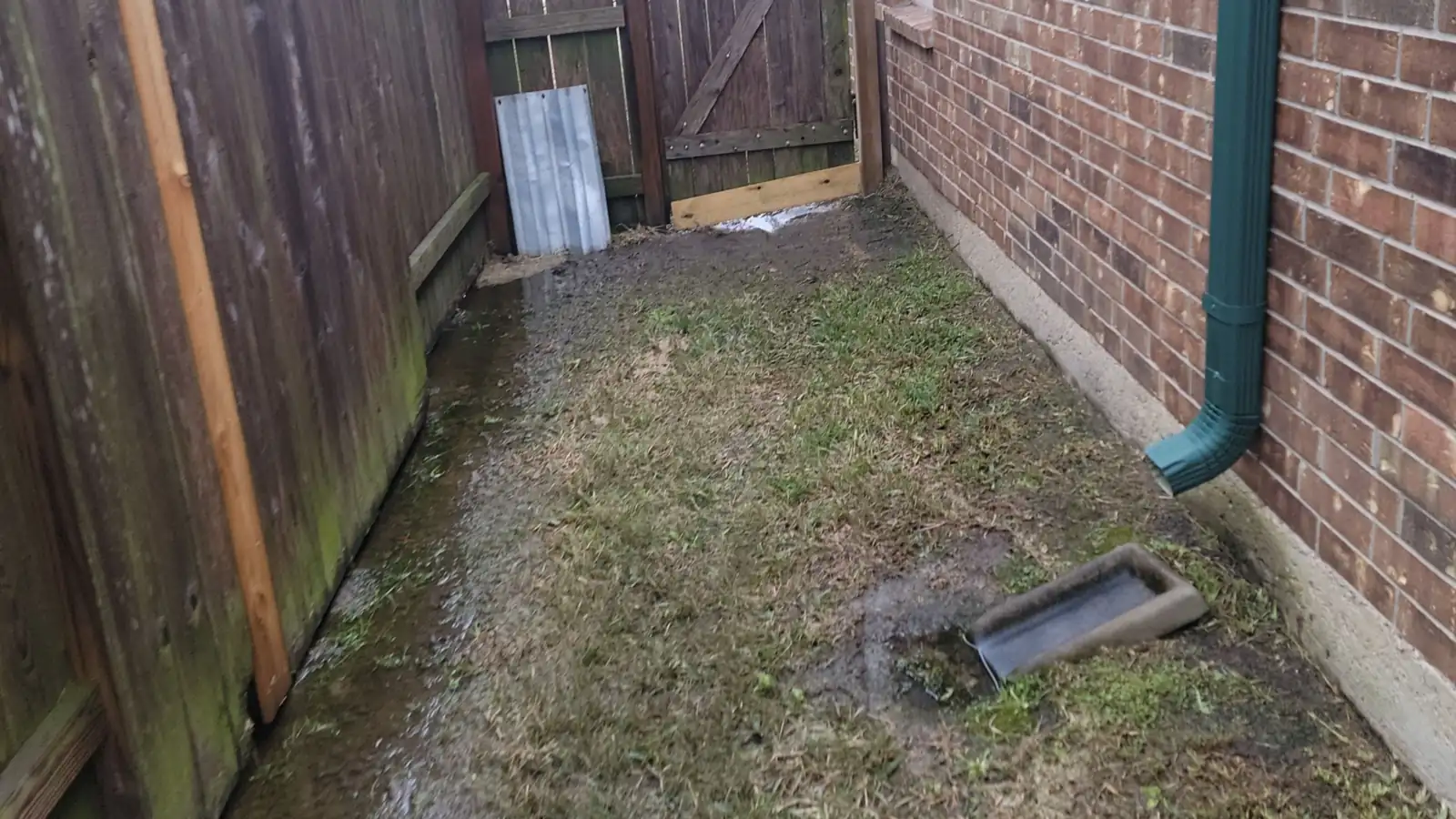
| Soggy strip down a narrow side yard | Two roofs and a flat path | Swale or French drain along the fence, with inlets at downspouts |
| Wet band along the back or side fence | Runoff from a higher neighboring lot | Interceptor swale or French drain along the line, piped to the street |
| Mulch and soil washed out of beds | Concentrated surface flow | Regrading, a swale, or an inlet where flow gathers |
| Water on the driveway or in the garage | Driveway sloping toward the house | Channel drain across the slab, tied to a solid pipe |
| Whole backyard soft for days, no outlet nearby | Yard lower than the street or ditch | Collection drains feeding an outdoor sump pump |
The table is a starting point. On a visit we confirm the source before choosing the fix, because a puddle that looks like a soil problem is often a downspout hidden behind a shrub.
What are the main yard drainage solutions, and when does each one fit?
The main solutions are regrading, swales, French drains, catch basins, channel drains, underground downspout lines with pop-up emitters, outdoor sump pumps, dry creek beds and soil improvement. Each fits a specific kind of water. Surface fixes move water before it soaks in; subsurface fixes collect water already in the ground.
Regrading. Reshaping the soil so the ground falls away from the house and toward an exit. Fits when the yard slopes the wrong way or settled after construction. It is the foundation of most plans and is covered in depth on our grading and swales page.
Swales. A broad, shallow, grassed channel that guides surface water along a path. Fits side yards and back lot lines where runoff needs a lane. It needs room and a little fall along its length.
French drains. A gravel trench with perforated pipe that collects water from saturated soil. Fits ground that stays wet after the rain stops. It is the wrong tool for a sudden sheet of surface water. Our French drain installation page covers how one is built.
Catch basins and surface inlets. A grated box at a low point that takes in surface water and sends it through solid pipe. Fits puddles, patio edges and downspout feet. See our catch basins page.
Channel drains. A long, narrow grated trough set into concrete. Fits driveways, garage aprons and patios where water crosses a hard surface. See channel drains.
Downspout lines and pop-up emitters. Solid pipe that carries roof water underground to a curb outlet or to a pop-up emitter in a lower part of the lawn. Fits any house whose downspouts empty beside the slab.
Outdoor sump pumps. A buried basin and pump that lifts collected water to a point gravity cannot reach. Fits yards that sit lower than the street or ditch. See sump pumps.
Dry creek beds. A rock-lined swale. Fits where a swale would erode or where a decorative look matters. It moves water; it does not absorb it.
Aeration and topdressing. Core aeration with a sandy topdressing helps compacted turf take in light rain. Fits mild sogginess. It will not fix a yard that has nowhere for water to go.
Why do dry wells and rain gardens struggle in Gulf Coast clay?
Dry wells and rain gardens work by letting water soak into the ground, and much of the soil around Houston and Galveston County barely lets water soak in. A pit or basin dug into that clay fills up and stays full. Both can still be used, but only with a pipe or overflow that carries water to a real outlet.
The soil facts behind this are published. The USDA Natural Resources Conservation Service describes the Lake Charles soil series, an extensive clay of southeast Texas between the Colorado and Trinity Rivers, as having very slow permeability. The same description notes 45 to 60 percent clay and runoff rated high on slopes of 0 to 1 percent, which is exactly the flat ground many local yards sit on.
"Very slow" is a defined class. NRCS soil survey guidance places very slow permeability at under 0.06 inch per hour. At that rate a dry well holding a foot of water could take days to empty through its floor, and a summer storm can refill it long before then.
There is a twist that fools homeowners. The NRCS description also notes that these clays crack when dry, with cracks up to about 2 inches wide, and that water enters quickly while the cracks are open but slowly once the soil is wet and they close. A new dry well can seem to work through a dry August and then fail in a wet October.
Stormwater engineers plan around soils like this. The Minnesota Pollution Control Agency's stormwater manual, a widely used design reference, says infiltration trenches and basins are not recommended in soils that infiltrate at 0.06 inch per hour or less, and that bioretention, the engineering name for a rain garden, should be built with an underdrain in those soils.
So in our service area, a rain garden is designed as a planted low area with a perforated underdrain or a high overflow piped to the street, and a dry well is used, if at all, as a small buffer on a system that already has an outlet. We test how fast your soil takes water on site before recommending either.
How do you drain a narrow side yard?
A narrow side yard is drained by giving water one defined lane along its length, usually a shallow swale or a French drain beside the fence, with inlets where downspouts discharge, all running toward the street or the back of the lot. The lane must fall the whole way, because any flat stretch becomes the new puddle.
Side yards are the hardest part of most lots. They are often only a few feet wide, they collect roof water from two houses, they get little sun so the soil dries slowly, and they are crowded with AC pads, gas meters, fence posts and gates. Machines often cannot fit, so trenching is done by hand or with compact equipment.
The usual design pieces are a grate at each downspout, a solid pipe for roof water, and a separate perforated line or a shaped swale for the ground water. Where a concrete walk fills the side yard, a channel drain cut into the walk can replace the swale. Where the fence sits on a low concrete mow strip, water may need a path under it, which is something to agree with the neighbor before digging.
What can you do about a low spot in the middle of the yard?
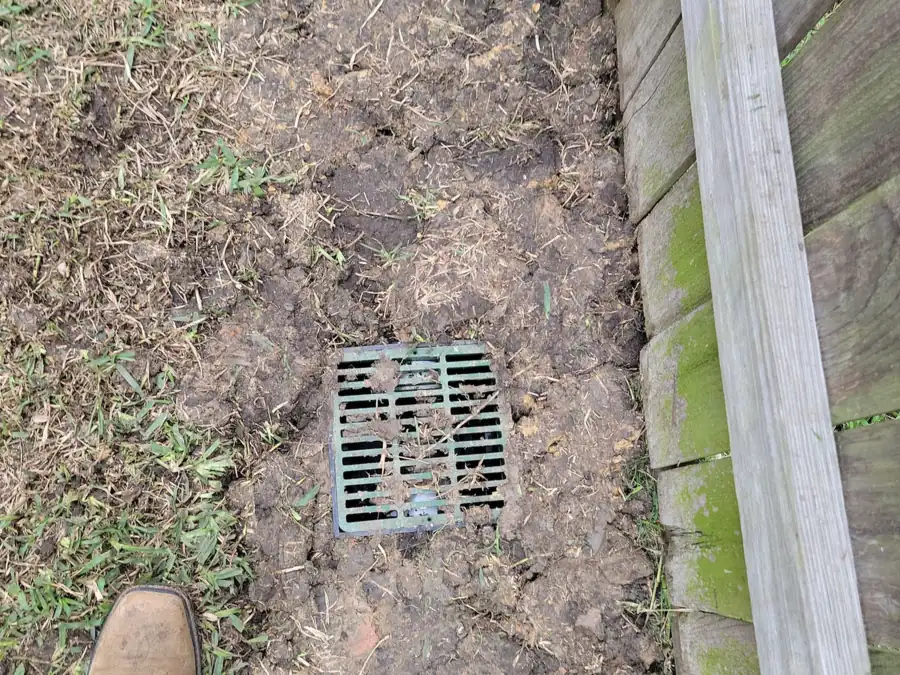
A low spot can be filled, drained with an inlet, or drained from below with a French drain. Filling works for shallow dips with lower ground nearby. An inlet works when surface water pools there during storms. A French drain works when the soil around the low spot stays wet long after the surface water is gone.
Filling is the simplest fix, but it has a trap. Adding soil to one low spot can push the water somewhere else, often toward the house or a neighbor. Before filling, check where the water will go once the dip is gone. If the answer is nowhere, filling only moves the puddle.
When an inlet is the answer, it sits at the lowest point with its grate just below the finished grass so water runs in. A solid pipe then carries it to the street or another outlet. In a backyard with a long run to the street, the pipe depth at the far end decides whether gravity works. If the pipe would have to come out below the curb, the plan changes to a sump pump.
Low spots also come from the past. Old tree stumps rot and settle, utility trenches sink, and pool or room additions disturb the soil. Those dips tend to keep settling, so we compact fill in layers rather than dumping it.
What if runoff comes from a neighbor's yard?
Runoff from a higher neighboring lot is common on subdivided land, and Texas law speaks to it. Texas Water Code section 11.086 says no person may divert or impound the natural flow of surface waters in a manner that damages the property of another by the overflow of that water, and an injured owner may recover damages.
That cuts both ways for a homeowner. You generally cannot solve your problem by building a berm or wall that pushes the water back or sideways onto someone else. And a neighbor who regrades, raises a slab or builds a wall that sends new water onto your lot may be acting against that rule. We are drainage contractors, not lawyers, so for a dispute over who is responsible, talk to a Texas real estate attorney.
The practical fix is usually to accept the water and give it a path. An interceptor swale or French drain along the shared line catches flow as it crosses, and solid pipe carries it to the street or another approved outlet without sending it onto a third lot. A conversation with the neighbor first often helps, since a joint fix along the fence can cost each house less than two separate ones.
If your subdivision has a homeowners association, its deed restrictions may also cover grading changes, fences and where drains may discharge. We check those points with you while planning, before anything is built.
Where can yard drainage water go?
Yard drainage water has to end at a legal, lower outlet: usually the street curb, a roadside ditch, a storm inlet, a back-of-lot drainage easement, or, where none is reachable by gravity, a sump pump that lifts it to one. The outlet is chosen first, and every pipe in the plan is laid to fall toward it.
Rules on outlets vary by city, by subdivision and by whether the curb or ditch is public right-of-way. Some places allow a pipe through the curb face, some want it to end in the grass behind the curb, and some restrict tying into storm inlets. We confirm what applies at your address during planning, rather than assuming one rule fits every city in the service area.
When should yard drainage fixes be combined?
Combine fixes when a yard has more than one source of water, which is most yards that have stayed wet for years. Roof water goes into solid pipe, surface flow gets a swale or inlets, and saturated soil gets a French drain, all sharing one outlet. Fixing only the most visible source usually leaves the others still flooding.
Three combinations fit many flat clay lots:
- Side yard set: downspout lines plus a French drain or swale along the fence, both leaving through one curb outlet.
- Backyard bowl: light regrading to move water away from the slab, two or three inlets at the low points, and a solid pipe to the street, or a sump if the street is higher.
- Driveway and garage: a channel drain across the slab tied to the same outlet line as the front downspouts.
Combining also saves cost. One outlet and one main pipe can serve several inlets, and trenches dug for one line can carry another. Planning everything at once avoids digging the same yard twice. If you are weighing a pipe against a surface channel, our French drain vs. swale guide compares the two directly.
If you already have a drain that stopped working, start with our French drain repair page, since a working line may only need its outlet opened before anything new is added.
What should you note before a drainage assessment?
Note where water stands, how long it stays, and where it seems to come from, ideally during and right after a heavy rain. A few phone photos with the time on them, plus a rough sketch of downspouts, beds and fences, let a drainage visit start from evidence instead of guesses, even on a sunny day.
A short checklist helps:
- Timing. Does the water appear during the storm, or only after it stops? During points to surface flow or roof water; after points to soil water.
- Duration. Is the spot dry by the next afternoon, or still soft three days later? Long-lasting wetness is the sign of a soil or outlet problem.
- Downspouts. Where does each one empty? Count them, and note any that end in a splash block against the slab.
- Changes. Has anything been built, poured or planted in the last few years: a patio, a pool, a fence, a raised bed, a neighbor's addition?
- Existing drains. Are there grates, pop-up caps or pipe ends in the yard or at the curb? Do you know where they lead?
- Inside clues. Any musty smell in the garage, damp baseboards, or new cracks in drywall near the wet side of the house?
None of this needs tools, and all of it shortens the path to the right plan. If you are not sure about an answer, leave it blank; the walk-through fills the gaps.
How is a yard drainage project priced?
A yard drainage project is priced from the parts it needs: the length of pipe and trench, the number of inlets and emitters, how much soil is moved, any concrete cut for a channel drain, the distance to the outlet, and whether a pump is required. Access matters too, since hand-dug side yards take longer than open lawns.
We do not publish a one-size price, because two yards with the same puddle can need very different plans. After the free on-site assessment you get a written quote that lists each piece, so you can see what each part of the plan costs and choose the order to build it. Use the form on this page or request a quote to set up the visit.
Other drainage services
French Drain Installation
A perforated pipe in a gravel trench that collects water below the surface and carries it to a safe outlet.
Learn more →French Drain Repair
Clogged, crushed or silted-up drains diagnosed and repaired, or rebuilt when the old one cannot be saved.
Learn more →Catch Basins
A grated box set at the low spot that catches surface water and sends it into an underground pipe to the outlet.
Learn more →Channel and Trench Drains
A long grated channel across a driveway, patio or garage entry that stops sheet runoff before it reaches the house.
Learn more →Downspout Drain Lines
Solid underground pipe that carries roof water from each downspout to the street or an outlet instead of the foundation.
Learn more →Sump Pumps
For lots with no downhill exit: a basin and pump that lift collected water up and out to where it can drain.
Learn more →Grading and Swales
Reshaping the ground, or cutting a shallow channel, so surface water flows away from the house on its own.
Learn more →
Yard drainage questions
What is the first step in fixing a yard drainage problem?
Watch the yard during and just after a real rain and note where water enters, which way it moves and where it stops. Photos or a short video from that hour show more than any description, because by the next morning the surface flow is gone and only the puddle that it left is visible.
Does a dry well work in clay soil?
Rarely for long. A dry well holds water underground and lets the surrounding soil absorb it, and the very slowly permeable clays common around Houston and Galveston County absorb little once they are wet. It may seem to work during a dry spell and then sit full through a wet week, when it is needed most.
Can I build a rain garden in a Houston-area clay yard?
Yes, as a planted low area with an underdrain or an overflow pipe to a real outlet, rather than as a basin that relies on soaking in. Without that outlet, a rain garden in heavy clay tends to hold standing water for days, which kills many plants and draws mosquitoes.
My neighbor's yard drains into mine. What are my options?
Start by talking to the neighbor, since a shared swale or a drain along the property line often fixes both yards. On your own side, a swale, inlet or French drain along the line can catch the flow and carry it to the street. Texas Water Code section 11.086 limits diverting surface water in ways that damage another property, so for a dispute, ask a lawyer.
Is it better to fill a low spot or drain it?
Fill it when the dip is shallow, sits away from the house and the soil around it still falls toward an outlet, since a few inches of sandy topsoil and new sod remove the hollow for good. Drain it when the dip is deep, catches water from a large area, or has no lower ground nearby for water to move to.
How long does a yard drainage project take?
A single downspout line or one catch basin is often finished in a day. A French drain along a side yard plus regrading and several inlets can take a few days, longer if rain stops work or concrete has to be cut. You get the expected schedule with the written quote after the site visit.
Will yard drainage work raise my water bill or need electricity?
Gravity systems such as swales, French drains, catch basins and downspout lines use no power and no water. Only an outdoor sump pump needs electricity, and that is used where the yard sits too low for gravity to reach the street or a ditch.
Stop the standing water before the next storm
Tell us where the water collects. We will come out, find where it should go, and give you a price.