
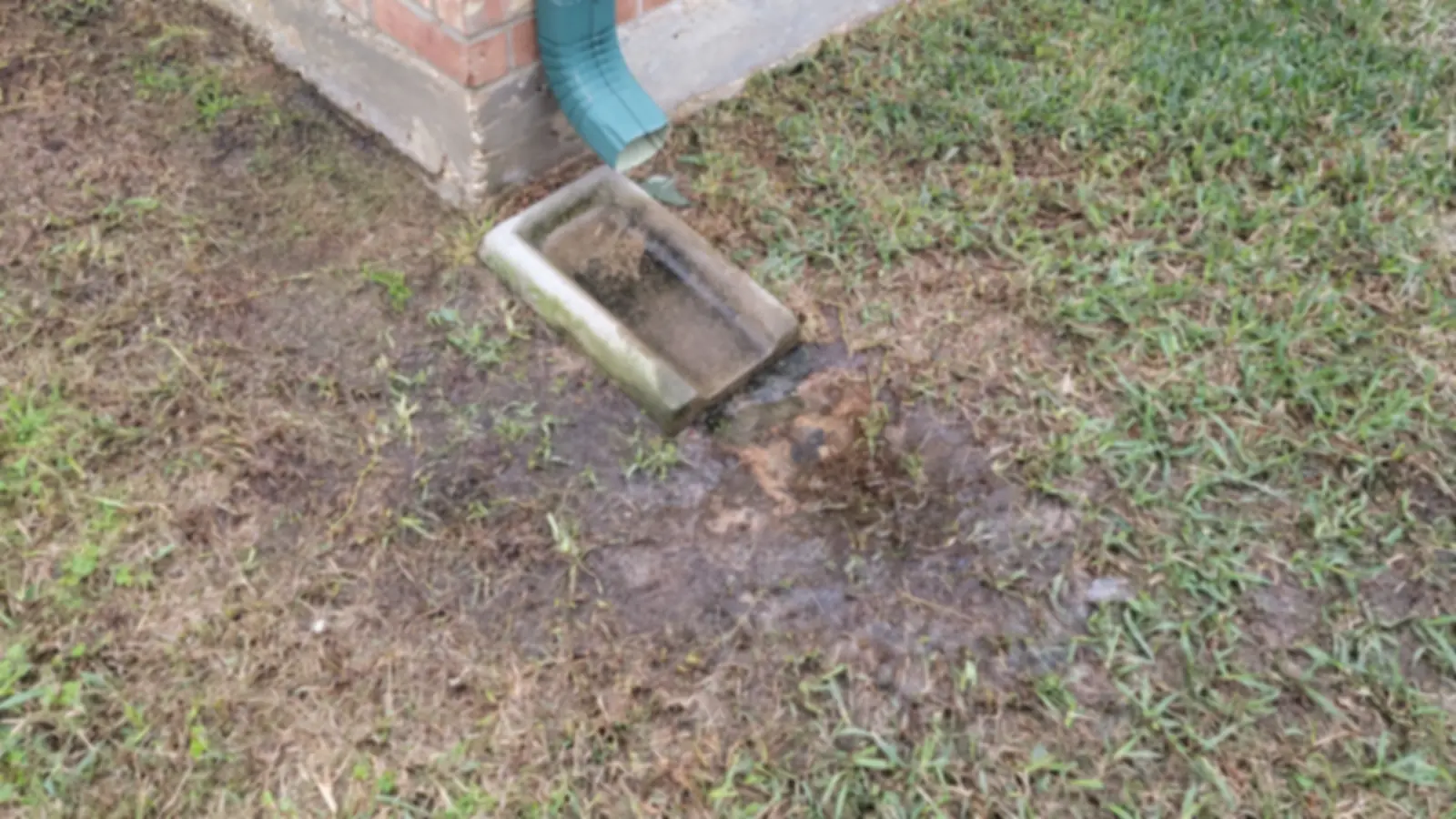
Underground Downspout Drain Lines
A roof is the largest water collector on your lot, and gutters funnel all of it to a handful of downspouts. Left to empty at the wall, each one soaks the soil beside the slab and floods the beds. An underground downspout drain carries that water in buried solid pipe to the curb, a pop-up emitter or a catch basin, out of sight and away from the foundation.
- Free on-site assessment
- French drains and yard drainage
- Repairs to existing drains
- Office in League City
How much water comes off your roof in one storm?
Every inch of rain on a square foot of roof yields about 0.62 gallons. The USGS puts one inch on an acre at about 27,154 gallons; divide by the 43,560 square feet in an acre and you get that figure. A house with a 2,000-square-foot roof footprint sheds roughly 1,250 gallons per inch of rain.
Measure the footprint, not the shingle area. Rain falls straight down, so a steep roof catches no more water than a flat one covering the same ground. The outside dimensions of the house plus the overhangs give you the number.
| Roof footprint | Gallons per 1 inch of rain | Gallons per 3-inch storm |
|---|---|---|
| 1,500 sq ft | about 935 | about 2,800 |
| 2,000 sq ft | about 1,250 | about 3,740 |
| 2,500 sq ft | about 1,560 | about 4,680 |
| 3,000 sq ft | about 1,870 | about 5,610 |
Now divide by the downspouts. A 2,000-square-foot roof with four downspouts sends around 310 gallons per inch of rain down each one, all of it landing in a space the size of a splash block. That is why the bed below a downspout erodes, and why the soil against the slab there stays wet long after the lawn has dried.
Why bury a downspout line instead of using a splash block?
A splash block moves roof water a foot or two. On a flat lot with slow-draining clay, that water turns around and sits against the house. A buried line carries it to a place lower than the slab and far from it, and leaves nothing on the lawn to trip over, mow around or kick loose.
Above-ground extensions help, but they have limits. Flexible extenders get moved, crushed by mowers, and disconnected by the first hard storm. They also only reach as far as the edge of the bed, which on many lots is still sloped toward the house.
A buried line solves three problems at once:
- Distance. The water leaves the yard entirely, or reaches a spot that drains away from the house.
- Erosion. No more washed-out mulch and bare trenches below each downspout.
- Moisture at the slab. The soil beside the foundation no longer gets a concentrated soaking every storm.
We start where the gutter work ends: the bottom of the downspout. Gutters themselves are a separate trade.
Should the pipe under a downspout be solid or perforated?
Solid. A downspout line has one job, which is to move roof water from the gutter to an outlet without losing any along the way. Perforated pipe leaks that water back into the soil next to the house, the exact place you are trying to keep dry, and lets roots and silt into the line.
Perforated pipe belongs in a French drain, where the goal is to collect water from the soil. Mixing the two jobs in one pipe causes most of the downspout-line failures homeowners describe.
| Pipe type | Use under a downspout? | Notes |
|---|---|---|
| Smooth-wall solid PVC (such as SDR-35 or Schedule 40) | Yes | Holds grade, flushes clean, takes cleanouts and sweeps |
| Solid corrugated HDPE | Sometimes | Flexible and quick to lay, but its ribs catch grit and it can sag in soft ground |
| Perforated pipe of any kind | No | Leaks roof water at the foundation and invites roots |
Fittings matter as much as pipe. Long sweep bends instead of sharp elbows keep leaves moving. A downspout adapter with a removable screen or leaf trap at the top of each line stops most debris before it goes underground.
Where can an underground downspout line end?
At the street curb, a roadside ditch, a drainage easement, a pop-up emitter in a lower part of the yard, or a catch basin that already has a working outlet. The choice depends on what is lower than the downspout and how far away it is. The line cannot discharge onto a neighbor's property.
- Curb outlet. The most reliable end point in a subdivision. The pipe exits through the face of the curb into the street gutter. Because the curb sits in the public right-of-way, the street's owner sets the rules, and we confirm what applies to your address before coring.
- Pop-up emitter. A spring or hinged lid at the end of the line that opens when water arrives and closes when it stops.
- Catch basin. Roof water joins a yard basin and shares its outlet pipe.
- Pump basin. Where nothing is lower, downspouts can feed a yard sump pump, though keeping roof water out of the pump when possible is better.
How do pop-up emitters work, and when do they fail?
A pop-up emitter is a round fitting at the low end of a downspout line, with a lid that sits flush with the lawn. When water fills the line, pressure lifts the lid and the water spills onto the grass. When the flow stops, the lid drops back. It works only where the ground beyond it carries water away.
Emitters fail in predictable ways:
- Placed too high. The emitter must sit below the downspout opening with fall the whole way, or water backs out the top of the downspout instead.
- Placed in a low spot. On flat clay lots, an emitter in a dip just moves the puddle. It needs to sit where the ground keeps falling.
- Standing water in the line. An emitter holds water in the pipe below its lid between storms. Some models have a small weep hole or a gravel pocket to let that residual drain.
- Grown over. Turf creeps across the lid until it cannot lift.
When the yard has no good emitter spot, a curb outlet or a tie-in to a basin is the stronger choice.
Why put a cleanout on every downspout line?
Because roof water is dirty. Leaves, pine needles, shingle grit and the occasional tennis ball all wash down the gutters. A cleanout is a capped riser at grade that opens straight into the line, so a hose or drain jetter can flush it without digging. Without one, a clog means excavation.
Good places for cleanouts:
- At the base of each downspout, just below the adapter.
- Where two or more branch lines join a main.
- On long runs, at intervals and at any change in direction.
Pair the cleanouts with a leaf trap at each downspout and most lines will go years between flushes. If a line you already have is backing up, our drain repair page explains how we trace and clear it.
Can downspouts tie into a catch basin or a French drain?
A catch basin, yes, when it has a working outlet and the shared pipe is sized for both. A French drain, generally no. Roof water arrives fast and dirty, and feeding it into a perforated pipe in gravel floods the trench at the moment it most needs capacity and slowly fills the stone with grit.
Tying into a catch basin works because the basin's sump traps debris before it reaches the outlet pipe, and the basin is an open inlet that can take a burst of water. The combined line downstream has to carry the roof flow and the yard flow together, which often means stepping up to a 6-inch main.
Where a French drain and downspouts share a property, the cleaner design runs them side by side in separate pipes, or joins them only downstream of the French drain's last perforated section, in solid pipe, at a cleanout.
How is a downspout line installed without wrecking the yard?
The trench is narrow, the sod is cut and set aside, and the soil is put back in the same trench. Before any digging, utilities are located; Texas811 asks for the request at least two business days ahead, not counting weekends and holidays. Then the outlet height is checked, the line is laid with fall, tested with water, and covered.
- Locate and plan. Utilities marked, each downspout's route drawn, outlet elevation measured.
- Cut and lift sod. Strips come up in rolls and are kept moist.
- Trench. Narrow and only as deep as the fall requires.
- Lay pipe. Solid pipe, sweeps at turns, cleanouts at the downspouts and junctions.
- Connect. Downspout adapter with a leaf trap at the top of each line.
- Water test. A hose in each downspout while someone watches the outlet.
- Backfill and relay sod. Soil tamped in lifts, sod pressed back and watered.
What drives the price of underground downspout drains?
Cost follows the number of downspouts, the total length of pipe to the outlet, and what the route crosses. A curb outlet, a bore under a sidewalk or driveway, and restoring beds all add to it. We do not post prices; you get a written number after a free on-site assessment that walks every downspout.
- How many downspouts, and whether they can share a main.
- Distance from the farthest downspout to the outlet.
- Concrete or sidewalk crossings on the way to the street.
- Emitter, curb outlet or tie-in to an existing basin.
- Bed, edging and sod restoration.
To have every downspout traced and a route marked, request a quote or call 713-979-9569.
Other drainage services
French Drain Installation
A perforated pipe in a gravel trench that collects water below the surface and carries it to a safe outlet.
Learn more →French Drain Repair
Clogged, crushed or silted-up drains diagnosed and repaired, or rebuilt when the old one cannot be saved.
Learn more →Yard Drainage
Standing water, soggy low spots and runoff toward the house, solved with the right mix of drains and grading.
Learn more →Catch Basins
A grated box set at the low spot that catches surface water and sends it into an underground pipe to the outlet.
Learn more →Channel and Trench Drains
A long grated channel across a driveway, patio or garage entry that stops sheet runoff before it reaches the house.
Learn more →Sump Pumps
For lots with no downhill exit: a basin and pump that lift collected water up and out to where it can drain.
Learn more →Grading and Swales
Reshaping the ground, or cutting a shallow channel, so surface water flows away from the house on its own.
Learn more →
Downspout drain line questions
What size pipe should an underground downspout drain use?
Four-inch pipe is the standard for residential downspout lines, because it carries far more than a typical downspout can deliver and resists clogging. Where several downspouts join one main, that main is sized for their combined roof area. Three-inch pipe is sometimes used for a single short run but has less room for leaves.
How deep are underground downspout lines buried?
Deep enough to stay below mowers, edgers and aeration, and to keep cover over the pipe, but shallow enough to keep fall all the way to the outlet. On flat lots the outlet height sets the depth, which is why the curb or emitter elevation is measured before any digging starts.
Why does my pop-up emitter never pop up?
Either the line is clogged with leaves and roof grit, the emitter sits higher than the downspout end so water cannot reach it, or grass has grown over the lid. A water test at the downspout shows which: if water backs out at the top, the line is blocked or too flat.
Should I put a leaf filter on the downspout connection?
Yes, on any roof with trees nearby. A screened leaf trap or a downspout adapter with a cleanout catches leaves and shingle grit before they enter the buried pipe. It needs emptying a few times a year, which is easier than digging up a clogged line.
Can two downspouts share one underground line?
Yes, and most systems do. Branch lines from each downspout join a main with sweep fittings, and the main is sized for the combined roof area. A cleanout near each junction lets the main be flushed without disturbing the yard.
Will an underground downspout line freeze or crack?
A buried line that drains completely after each storm holds no standing water to freeze, so freezing is seldom the issue. Cracks usually come from shallow pipe under a driveway edge or from roots, which is why lines are run deep enough and in solid pipe.
Do downspout drains help with foundation movement?
They keep large amounts of roof water from soaking the soil at the slab edge, which helps keep moisture around the foundation more even. They are one part of drainage around the house, alongside grading that slopes away from the slab; they are not a foundation repair.
Stop the standing water before the next storm
Tell us where the water collects. We will come out, find where it should go, and give you a price.