
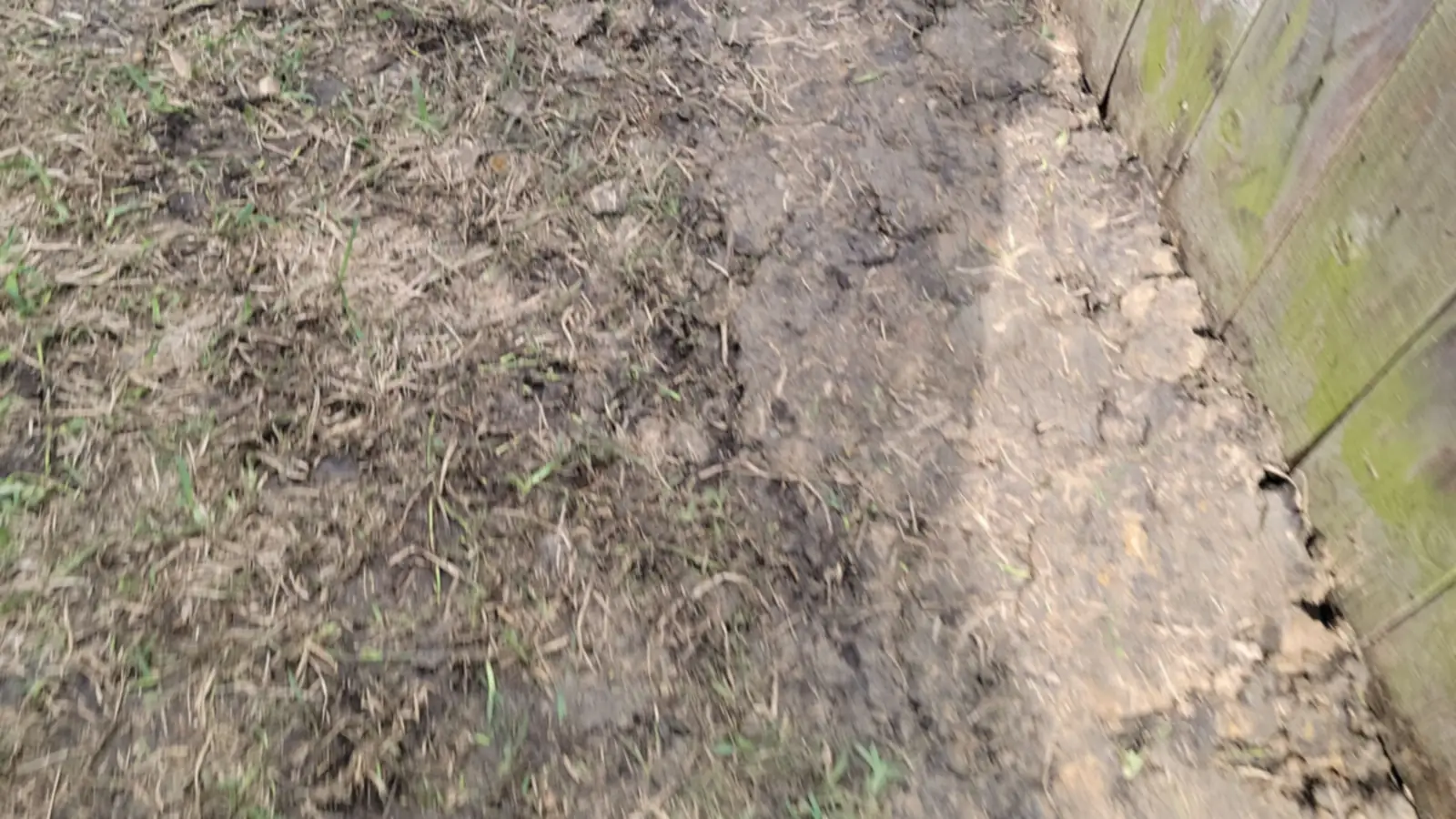
French Drain Installation, Built for Gulf Coast Clay
A French drain is simple to describe and easy to get wrong. This page covers what goes in the trench, how deep and how steep it should run, how far it sits from the slab, who calls 811, and the shortcuts that make drains in our clay soil fail within a few seasons.
- Free on-site assessment
- French drains and yard drainage
- Repairs to existing drains
- Office in League City
When is French drain installation the right fix?
A French drain is the right fix when water is moving through or sitting in the soil, along a line you can trace. Think of a side yard that stays mud, a strip behind the house that never dries, or ground water seeping toward the slab. If the water is mostly on the surface or coming off the roof, a different fix usually costs less.
Here is how we sort it on a site visit:
- Water pools at one spot and then disappears slowly. A catch basin at that low point, piped away, may be enough.
- Water sheets across concrete toward the garage. That calls for a channel drain set in the slab.
- The whole lot tilts toward the house. Reshaping the ground, or cutting a shallow swale, may move it with no pipe at all.
- Gutters empty against the wall. Solid downspout drain lines come first.
Many yards need a French drain plus one of these, all feeding one outlet. If you are unsure whether you need a buried drain or an open channel, our page on the French drain vs swale choice goes through it.
What materials go into a French drain that lasts?
Five parts: a perforated pipe, clean stone around it, filter fabric between the stone and the native soil, a cleanout for flushing, and solid pipe from the end of the collection zone to the outlet. Skipping or cheapening any one of them is how most drains end up silted shut. Your written quote should name each part.
| Component | What to look for | Why it matters here |
|---|---|---|
| Perforated pipe | 4-inch is the usual residential size; rigid PVC or flexible corrugated | Rigid pipe holds a straight grade on flat lots; corrugated sags where bedding is soft. |
| Stone | Clean, washed crushed stone around 3/4 inch, with no fines | Fines and small round gravel pack tight and stop the flow. |
| Filter fabric | A non-woven geotextile lining the trench and wrapping the stone | Keeps clay particles from migrating into the stone and pipe. |
| Cleanout | Capped riser at the upper end of the line | Lets the line be flushed or camera-checked without digging. |
| Solid outlet pipe | Non-perforated pipe from the collection zone to the outlet | Stops collected water leaking back into the soil on its way out. |
Pipe size follows the water. Drain manufacturer NDS describes a 4-inch perforated pipe as likely adequate for most residential uses, with larger pipe where heavy saturation is expected. This Old House lists 4-inch perforated pipe and 3/4-inch gravel as the standard materials. A yard that also takes several downspouts or a big catch basin may need a larger solid line to the outlet.
The pipe goes in with the holes facing down, set on a bed of stone rather than on bare clay. Water rises through the stone and enters from below. Then more stone covers the pipe, the fabric folds over the top, and soil and sod go back on.
How deep and how steep should a French drain be?
Most yard drains run between about 8 inches and 2 feet deep, and they must fall continuously toward the outlet. NDS gives 8 inches to 2 feet as enough for many projects and a minimum fall of 1 percent, with some experts asking 2 percent for corrugated pipe. One percent is roughly an inch of drop for every eight feet of pipe.
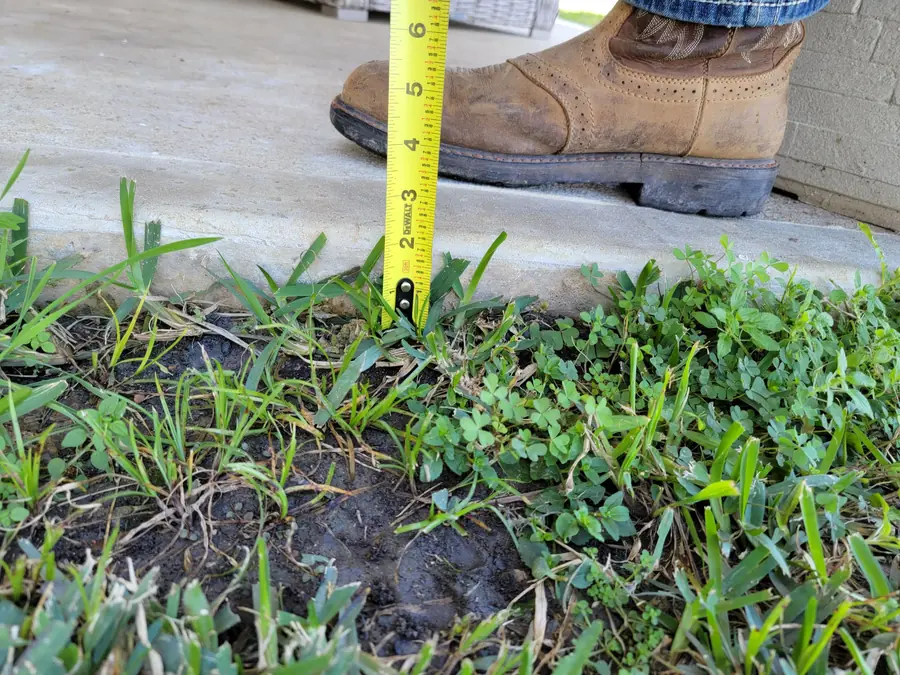
On a flat Gulf Coast lot those numbers fight each other. Every foot of pipe drops the line a little lower, and the outlet still has to sit below the lowest point of the pipe. A 100-foot run at 1 percent falls a full foot. If the curb is only a few inches below the backyard, there is no room for that much drop by gravity.
That trade-off is why we measure elevations on the first visit. The options when fall runs short:
- Shorten the run by splitting the yard into two drains with two outlets.
- Start the upper end shallower, keeping enough cover to protect the pipe.
- Use rigid pipe, which holds a low grade more accurately than flexible pipe.
- End the line in a basin with a yard sump pump that lifts the water out.
Steeper is not always better. Very fast flow can scour the outlet and erode the ground where the water leaves. The aim is steady, even fall with no low spots where water can sit inside the pipe.
How far from the foundation should a French drain go?
Far enough not to disturb the soil that holds up the slab, and close enough to catch water headed for it. This Old House advises placing a foundation drain at least two feet from the foundation wall so the trench does not undermine the structure. On a narrow side yard, that often puts the line near the middle.
The drain also works alongside the ground's own slope. The International Residential Code, which Texas Local Government Code section 214.212 adopts as the municipal residential building code, says in section R401.3 that the grade should fall at least 6 inches within the first 10 feet from the foundation. Where lot lines, walls or other barriers make that impossible, the code calls for drains or swales to carry water away.
That exception describes most zero-lot-line side yards in new subdivisions. There is not ten feet to work with, so the drain does the job the slope cannot. We set the trench where it will intercept water before it reaches the slab, and keep it clear of fence footings and the beam along the slab edge.
Which outlet should the drain empty into?
The outlet has to sit lower than every point of the pipe and be a place the water is allowed to go. In practice that is the street curb, a drainage ditch, an approved storm connection, a pop-up emitter on a lower part of your own lot, or a pump basin. It is never a neighbor's yard.
In clay, pop-up emitters need extra thought. An emitter releases water onto the lawn, and on very slowly draining clay that water may sit right where it surfaced. We use emitters where there is genuinely lower ground well away from the house, and prefer a curb or ditch outlet where one is within reach.
Wherever the line ends, the outlet needs to stay visible and clear. A buried or grassed-over outlet is the most common reason a sound drain stops working. The homepage has a fuller guide to outlet options.
Do you need to call 811 before installing a French drain in Texas?
Yes. Texas811 says state law requires you, or your contractor, to contact it at least two business days before digging, not counting weekends and holidays. The locate is free. When you hire a contractor, Texas811 puts the responsibility on the contractor, and you can ask for the ticket number before work starts.
Two points from the Texas811 FAQ catch homeowners off guard:
- Digging waits for both conditions. The two business days must pass and every notified utility must have marked, not one or the other.
- Private lines are not marked. Member utilities mark their own lines. Lines you own, such as sprinkler pipes, landscape lighting, a gas line to an outdoor grill or a line to a detached shed, are the owner's responsibility, and a private locator charges for them.
Tell us about anything you know is buried before the dig. Sprinkler lines in particular cross most French drain routes. We plan each crossing with you before the dig, including how any line that has to be cut gets repaired.
Can a French drain be installed under existing grass?
Yes. The sod along the route is cut and lifted before the trench is dug, kept moist and laid back over the finished drain. Spoil goes on tarps rather than on the surrounding lawn. Afterward the trench line usually shows as a visible stripe that fills in over the following weeks as the grass roots in.
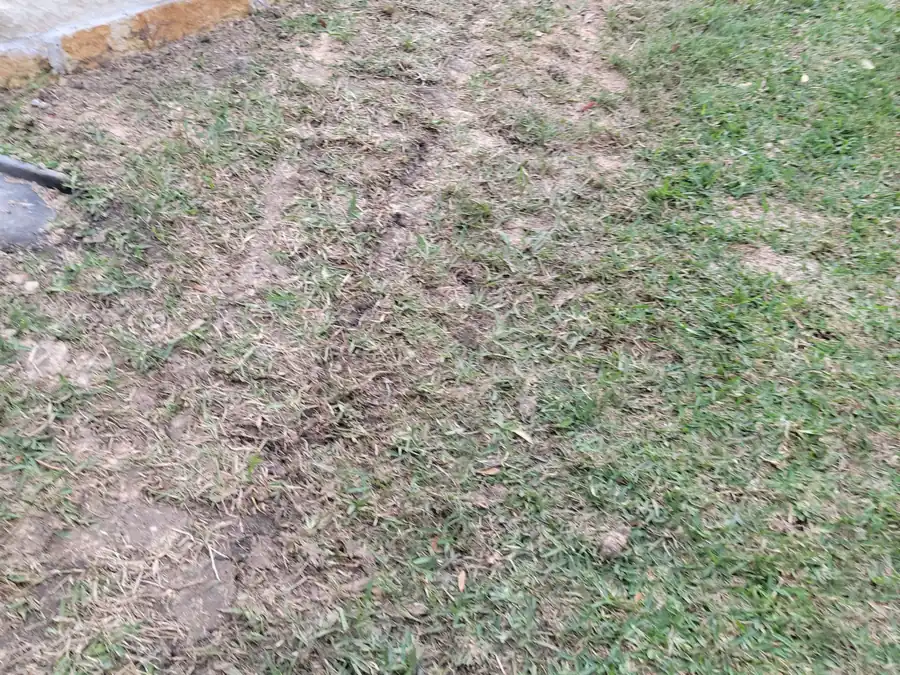
Some things make restoration harder. Where the trench runs through beds, plants are lifted and replanted. Under walkways or a patio edge, the concrete may have to be saw-cut and patched, or the line routed around it. We walk the route with you before digging so there are no surprises about what gets disturbed.
Settling is normal. Backfill over a new trench compacts over the first few rains, and a low line can appear. A thin top-up of soil levels it.
What makes one French drain cost more than another?
Footage, depth, access and the outlet drive the price, roughly in that order. Two yards with the same footage can differ a lot in work, so we do not quote by the foot over the phone. See what drives French drain cost; you get a written price after the free on-site visit, built from your yard's measurements.
- Length of perforated and solid pipe. The run through the wet zone plus the solid run to the outlet.
- Trench depth. A deeper trench in dense clay means more digging, more stone and more spoil to handle.
- Access. A narrow side yard or a backyard behind a fence with no gate can rule out machines and turn it into hand work.
- Obstacles. Tree roots, sprinkler crossings, beds and concrete that must be cut and patched.
- The outlet. A curb outlet in reach is simple; a long run or a pump basin adds cost.
- Extras on the same system. Catch basins, downspout lines, cleanouts.
Whoever you hire, a quote worth comparing names the footage, the pipe type, the stone, the fabric, where the outlet is and how the lawn is restored. A single number with no scope makes two bids impossible to compare.
Which shortcuts make French drains fail in clay soil?
Clay punishes shortcuts because its particles are fine and it barely passes water. In federal soil data for Galveston County, Lake Charles clay runs about 50 to 61 percent clay and in its slowest layers passes water at about one-hundredth the rate of the loam mapped at our League City office. Five shortcuts cause most failures.
- No fabric, or the wrong kind. Without a filter layer, clay fines wash into the stone and seal it. NDS notes that clay can clog a French drain by carrying fine particles into the aggregate.
- Dirty or rounded gravel. Stone with fines, or small round pea gravel, packs into a dense layer. Clean, angular stone keeps open space for water.
- Pipe laid on bare clay. A pipe set straight on the trench floor sinks unevenly and develops bellies, low spots that hold water and collect silt.
- Downspouts piped into the perforated line. Roof water arrives in a surge carrying grit. It overloads the pipe, pushes water back into the soil and fills the line with sediment.
- No cleanout, and an outlet nobody can find. When the drain eventually needs flushing, there is no way in and no visible exit to check.
Clay also moves. The U.S. soil series description says Lake Charles soil cracks 1/2 to 2 inches wide and a foot or more deep when dry, with cracks open 60 to 90 days in most years. In the federal data it shows linear extensibility of 11 to 17 percent, a measure of swelling. A rigid, well-bedded pipe holds its grade through that movement far better than a sagging flexible one.
If you already have a drain showing these symptoms, the French drain repair page explains how a failed line is diagnosed and whether it can be saved.
What maintenance does a new French drain need?
Very little, if it was built right. Keep the outlet clear of grass clippings, leaves and mulch, and look at it after a heavy rain to confirm water is coming out. Every so often, flush the line through the cleanout with a garden hose, and call for a jetting if water starts backing up.
Watch for early warnings: an outlet that stays dry during a storm, a wet strip returning along the trench, or a sinkhole forming over the pipe. Each one points to a specific fault that is cheaper to fix early. When you are ready for a measured plan and a written price, request a free quote.
Related drainage services
French Drain Repair
Clogged, crushed or silted-up drains diagnosed and repaired, or rebuilt when the old one cannot be saved.
Learn more →Yard Drainage
Standing water, soggy low spots and runoff toward the house, solved with the right mix of drains and grading.
Learn more →Catch Basins
A grated box set at the low spot that catches surface water and sends it into an underground pipe to the outlet.
Learn more →Channel and Trench Drains
A long grated channel across a driveway, patio or garage entry that stops sheet runoff before it reaches the house.
Learn more →Downspout Drain Lines
Solid underground pipe that carries roof water from each downspout to the street or an outlet instead of the foundation.
Learn more →Sump Pumps
For lots with no downhill exit: a basin and pump that lift collected water up and out to where it can drain.
Learn more →Grading and Swales
Reshaping the ground, or cutting a shallow channel, so surface water flows away from the house on its own.
Learn more →
French drain installation questions
Should the holes in French drain pipe face up or down?
Down. With the perforations at the bottom, water rising in the stone bed enters the pipe from below and the pipe carries it off as soon as the trench starts to fill. Holes facing up leave a few inches of standing water in the trench before the pipe takes any.
Is corrugated or rigid pipe used for a French drain?
Both are used. Flexible corrugated pipe bends around corners and installs fast, but it sags if the bedding is uneven and is harder to flush. Rigid perforated PVC holds a straight grade and takes a cleaning jet well. On long runs with little fall, rigid pipe is easier to keep on grade.
Can my gutter downspouts tie into the French drain?
Not into the perforated pipe. Roof water arrives in a rush and carries grit, and pushing it into a perforated line forces it back out into the soil you are trying to dry. Downspouts should run in their own solid pipe, joining the French drain only at a solid section near the outlet, or reaching the outlet separately.
How wide is a French drain trench?
Trench width varies with the job. Guidance in the industry ranges from about 6 inches for a small shallow drain to roughly 18 inches for a larger one. A wider trench holds more stone and more water, but it also means more digging and more lawn to restore, so width is sized to the amount of water.
Does a French drain need a cleanout?
A cleanout is a capped riser at the upper end of the line that lets the pipe be flushed or camera-inspected without digging. It adds a small cost at installation and saves a lot later, especially on drains that collect fine clay silt. We recommend one on most runs.
Who is responsible for calling 811, me or the contractor?
When you hire a contractor, Texas811 says it is the contractor's responsibility to request the locate at least two business days before digging. You can ask your contractor for the ticket number. Utilities mark only their own lines; private lines like sprinklers are the owner's to locate.
Can a French drain go along a fence line or in a narrow side yard?
Yes, and side yards are among the most common places one is needed. The trench has to stay clear of fence post footings and the slab edge, and the narrow space can limit equipment to hand digging or a compact trencher. That affects the schedule and price, not whether it can be done.
Stop the standing water before the next storm
Tell us where the water collects. We will come out, find where it should go, and give you a price.