
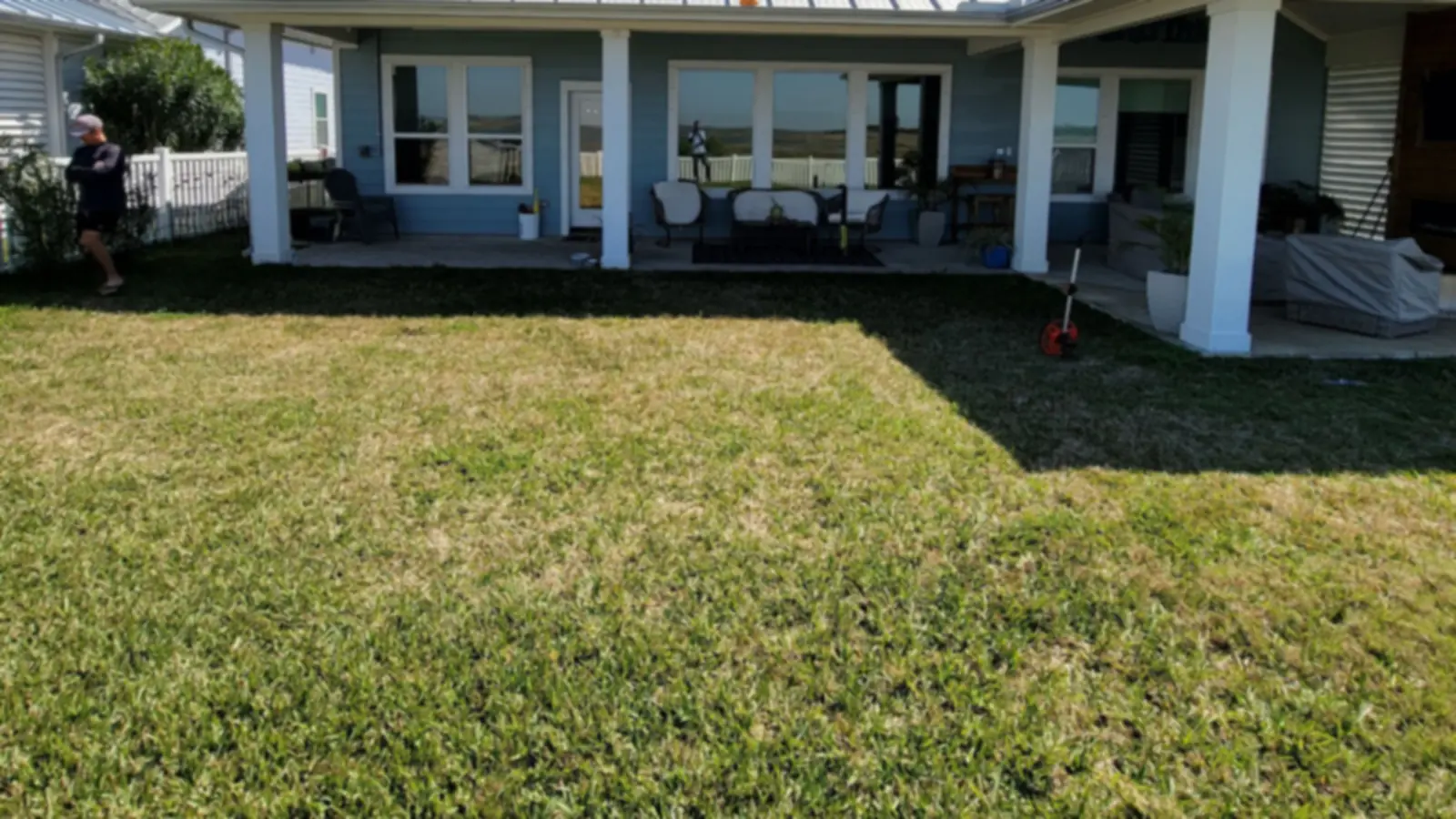
Outdoor Sump Pump Installation for Flat Yards
Some lots have no downhill. The backyard sits lower than the street, the side yard is boxed in by fences and slabs, and every drain line would have to run uphill to reach an outlet. An outdoor sump pump solves that: drains feed a buried basin, and a float-switched pump lifts the water out to the curb or another legal discharge point.
- Free on-site assessment
- French drains and yard drainage
- Repairs to existing drains
- Office in League City
When does a yard need a pump instead of gravity?
A yard needs a pump when the place water collects is lower than every place it is allowed to go. If a drain line from the wet spot cannot fall all the way to the curb, a ditch or an easement, gravity has run out, and the water must be gathered in a basin and lifted.
That situation is common on the flat coastal plain south of Houston. The clay soils that cover much of Southeast Texas, such as the Lake Charles series, sit mostly on slopes under 1 percent according to the USDA, and they take water in very slowly. Water has little reason to move and little room to soak in.
Add a few modern lot habits and the problem compounds:
- Backyards graded lower than the street during construction.
- Rear yards that drain to a fence line with a neighbor's slab on the other side.
- Pools, patios and additions that filled the only route water once had.
- Garages and driveways that end at the low corner of the lot.
Before recommending a pump, we always check whether a gravity route exists, because a pipe with no moving parts is the simpler system. Sometimes regrading or a shallow swale can create one. When it cannot, the pump earns its place.
How can you tell your lot has run out of gravity?
The signs are a drain that holds water at its outlet end, a catch basin that stays full between storms, and a puddle that sits at the lowest corner of the yard for days. Each one means the water reached the low point and stopped. A level survey confirms it in minutes.
- The old drain never empties. Open the grate the day after rain and the pipe is still full.
- The outlet is higher than the inlet. The pipe runs to the street, but the curb sits above the yard.
- Water pools against a fence. The fence line is the lowest place on the lot and there is no opening beyond it.
- The garage floods first. The driveway ends at the lowest point, below any drain that could serve it.
On the assessment we shoot elevations from the wet spot to every possible outlet. If none is lower, the answer is a pump; if one is lower by enough, a gravity French drain or catch basin line is the better build.
What size pump does a yard drain system need?
Pick the pump from its performance curve, not its horsepower label. Find the total head, which is the vertical lift from the basin to the highest point of the discharge plus friction loss in the pipe, then choose a pump that still moves enough water at that head. A pump that looks strong on the box can deliver little at a long, high run.
Three numbers drive the choice:
| What we measure | Why it matters |
|---|---|
| Vertical lift | Every foot the water climbs reduces how much the pump can move. |
| Discharge length and pipe size | A long run in narrow pipe adds friction that acts like extra lift. |
| Inflow during a heavy storm | The area draining to the basin sets how fast it fills; the pump must keep ahead. |
Undersizing is the obvious failure: the basin fills faster than the pump can empty it. Oversizing has its own cost. A pump much larger than the inflow empties the basin in seconds, shuts off, and restarts constantly, and short cycling wears out switches and motors. A larger basin smooths that out by giving the pump more water per cycle.
The pipe from the basin is sized with the pump. Discharge lines for yard pumps are smaller than the drain lines feeding the basin, solid-wall, matched to the pump's outlet, with a check valve so the water in the line does not drain back into the basin each time the pump stops.
Submersible or pedestal: which pump goes in a yard basin?
For outdoor yard basins, a submersible pump is the standard choice. It sits under the water at the bottom of a covered basin, cooled by the water around it, out of sight and out of the weather. Pedestal pumps keep the motor above the basin, which suits indoor pits but leaves a motor exposed in a yard.
Within submersibles, the decisions are smaller:
- Float type. Vertical floats suit narrow basins; tethered floats need room to swing. Either must be free of the basin wall and any debris.
- Solids handling. Yard water carries grit and leaves. A pump that passes small solids, sitting on a raised stand above the basin floor, lasts longer.
- Housing. Cast iron and stainless housings shed heat and resist corrosion better than all-plastic units.
The basin matters as much as the pump. A perforated or slotted basin wrapped in filter fabric and set on gravel can also take water from the soil around it. A solid basin only takes what the pipes bring.
Where can the pump discharge line go?
The discharge must end somewhere water is allowed to go and will flow away: the street gutter through a curb outlet, a roadside ditch, a drainage easement, or a pop-up emitter in a part of the lot that drains freely. It cannot go onto a neighbor's property, and storm water does not belong in the sanitary sewer.
Planning the route is the first design step, not the last. The route sets the lift, the lift sets the pump, and the pump sets the basin. A route that crosses a sidewalk or driveway may need a bore underneath. A route that ends at the curb sits partly in the public right-of-way, so we confirm what the city or county requires for that street. Some HOAs also review front-yard outlets.
A common pattern on flat lots is a short pumped line that lifts water to a higher point, then a longer gravity line from there to the curb. The pump only does the climbing, and the pipe does the traveling.
Roof water is often part of the load. Where downspouts can reach the street by gravity on their own underground downspout lines, keeping them out of the sump basin cuts how hard the pump has to work.
What does the electrical side of a yard pump involve?
A yard pump needs a weatherproof outdoor receptacle with ground-fault protection near the basin, on a circuit that can carry the pump's starting load. If no suitable outlet exists, a new circuit has to be run. Texas licensing rules treat that as electrical work, so plan on a licensed electrician for it.
The Texas Department of Licensing and Regulation states that anyone who performs electrical work in Texas must be licensed, with a short list of exemptions; one exempts an owner working on the home they live in, and cities can set stricter rules. A drainage crew digging the basin is not the right party to wire it.
On the assessment we note where the nearest outdoor receptacle is and whether it is ground-fault protected. If new wiring is needed, you will know before the job starts, and the electrical scope is spelled out separately in the quote.
Is a battery backup worth it on the Gulf Coast?
On a lot that floods without the pump, yes. The storms that fill a yard basin are the same storms that knock out power. When Hurricane Beryl came ashore on July 8, 2024, CenterPoint Energy had 2.26 million of its roughly 2.6 million Houston-area customers without power, S&P Global reported.
A backup system adds a second pump, a deep-cycle or sealed battery, a charger, and a controller that switches over when the main pump stops or the water rises past its float. It lives in a weatherproof enclosure near the basin.
- Battery backup pump. Runs for a limited number of hours depending on battery size and how often it cycles.
- High-water alarm. An inexpensive float alarm that sounds, or sends a phone alert, when the basin rises above normal.
- Generator inlet. If the house already has a portable generator plan, the pump circuit can be one of the loads it carries.
A backup is only as good as its battery. Batteries age, and a backup that has never been tested is a guess.
What maintenance does a yard sump pump need?
Test it, clean it, and look at the outlet. Each spring before storm season and after any major storm, lift the lid, clear debris from the basin, pour in water until the pump starts, and confirm it shuts off and the outlet flows. That five-minute check catches most failures before they matter.
- Float: make sure it moves freely and is not snagged on the cord or basin wall.
- Intake screen: clear leaves, roots and silt.
- Check valve: listen for a clean close; a valve stuck open lets the line drain back and cycles the pump.
- Discharge end: confirm the curb outlet or emitter is not buried or blocked.
- Backup battery: test it and replace it on the maker's schedule.
Which yard sump mistakes cause the most trouble?
Most problems trace back to a few install shortcuts: a basin with no sediment protection, a pump sized by horsepower instead of head, no check valve, a discharge line that ends at the wrong place, and a cord plugged into an unprotected outlet. Each is cheap to avoid during the build and costly to fix after.
A pump job should be designed as one system with the drains that feed it. If you have standing water and suspect gravity is the problem, request a quote or call our League City office at 409-572-6657 for a free on-site assessment and a written price.
Other drainage services
French Drain Installation
A perforated pipe in a gravel trench that collects water below the surface and carries it to a safe outlet.
Learn more →French Drain Repair
Clogged, crushed or silted-up drains diagnosed and repaired, or rebuilt when the old one cannot be saved.
Learn more →Yard Drainage
Standing water, soggy low spots and runoff toward the house, solved with the right mix of drains and grading.
Learn more →Catch Basins
A grated box set at the low spot that catches surface water and sends it into an underground pipe to the outlet.
Learn more →Channel and Trench Drains
A long grated channel across a driveway, patio or garage entry that stops sheet runoff before it reaches the house.
Learn more →Downspout Drain Lines
Solid underground pipe that carries roof water from each downspout to the street or an outlet instead of the foundation.
Learn more →Grading and Swales
Reshaping the ground, or cutting a shallow channel, so surface water flows away from the house on its own.
Learn more →
Yard sump pump questions
How deep is an outdoor sump basin?
Deep enough that every drain line feeding it arrives above the pump's on level, which on most yard systems puts the basin a few feet down. The exact depth is set by the lowest incoming pipe, and the basin sits on a gravel bed with a lid at grade so it can be opened for service.
How loud is a yard sump pump?
A submersible pump under a closed lid is quiet; most owners hear a faint hum and the click of the check valve when it shuts off. Noise usually means a problem: a pump cycling too often, a check valve slamming, or a discharge line rattling against something, all of which can be fixed.
Can a yard sump pump drain into the sewer cleanout?
No. Storm and groundwater are not supposed to go into a sanitary sewer, and doing so can overload the system and violate local rules. Yard pump discharge belongs at the street gutter, a ditch, a drainage easement or a pop-up emitter in a part of the lot that drains away.
What happens if my yard sump pump fails during a storm?
The basin fills, and the drains that feed it back up, so the yard floods to where it was before the system went in. A battery backup pump or a high-water alarm turns that from a surprise into a warning. Checking the float and pump each spring catches most failures in advance.
How long does an outdoor sump pump last?
Life depends on how often it runs and how much grit reaches it. A pump that cycles a few times per storm in a clean basin lasts far longer than one fighting silt or short-cycling every minute. Fabric around the basin, a sediment trap upstream and a correctly set float all extend it.
Is a sump pump the same as a French drain?
No. A French drain collects water from the soil and moves it by gravity. A sump pump moves water uphill when gravity cannot. On flat lots they often work together: the French drain empties into the sump basin, and the pump sends the water to a legal outlet.
Will I need a permit for a yard sump pump?
That depends on where you live. The electrical circuit and any work in the street right-of-way, such as a curb outlet, are the parts most likely to fall under city rules or an HOA approval. We check what applies to your address before the job is scheduled.
Stop the standing water before the next storm
Tell us where the water collects. We will come out, find where it should go, and give you a price.