Yard Grading and Drainage Swales
The cheapest drain is a yard that slopes the right way. When soil has settled, beds have built up, or an addition changed the levels, rain runs toward the slab instead of away from it. Regrading restores that fall, and a shaped swale gives the water a lane to the street, often with no pipe at all.
- Free on-site assessment
- French drains and yard drainage
- Repairs to existing drains
- Office in League City
What is positive grading, and why does it matter for a slab foundation?
Positive grading means the ground around a house slopes down and away from the foundation, so rain that falls near the walls runs off instead of soaking in beside the slab. It is the first line of yard drainage. Every other drain on the lot works better when the soil itself is already moving water outward.
A concrete slab built on clay that swells when wet and shrinks when dry is sensitive to uneven moisture. When the soil along one side stays wet while the rest dries, the ground under the house moves unevenly. Keeping water off the perimeter is one of the simple ways to keep moisture around the foundation more even.
Grading also costs less to keep working than anything with a pipe. There is nothing to clog, no outlet to bury and no pump to fail. The trade-off is that it needs room and fall, and some lots simply do not have enough of either.
What does the building code require for grading around a house?
The International Residential Code, section R401.3, requires lots to be graded so surface water drains away from foundation walls, with the grade falling at least 6 inches within the first 10 feet. That is a 5 percent slope. Texas law makes the IRC the base residential building code for cities, and cities may adopt local amendments.
The full rule, as published by building departments that reproduce the current code text, has four parts:
| Area | Minimum slope away from the house | What that looks like |
|---|---|---|
| Soil within the first 10 feet | 6 inches of fall in 10 feet (5 percent) | About 0.6 inch of drop for every foot out from the wall |
| Where lot lines, walls or slopes prevent that fall | 5 percent, with water sent to drains or swales | The grade still leaves the wall, then a swale or drain takes over |
| Swales within 10 feet of the foundation | 2 percent along the swale | About 1/4 inch of drop per foot of swale length |
| Patios, walks and other hard surfaces within 10 feet | 2 percent away from the building | About 1/4 inch per foot, falling away from the house |
Texas Local Government Code section 214.212 adopts the IRC as it existed on May 1, 2012 as the municipal residential building code in Texas. It also lets a city adopt local amendments by ordinance after a public hearing, and lets cities consider later ICC changes. In practice, the edition and amendments in force differ from city to city, so we check what applies at your address.
Older homes were built under whatever rules applied at the time, and years of landscaping can erase what was there on day one. The code numbers are still a useful target when restoring grade on any house.
How can you measure the grade around your house?
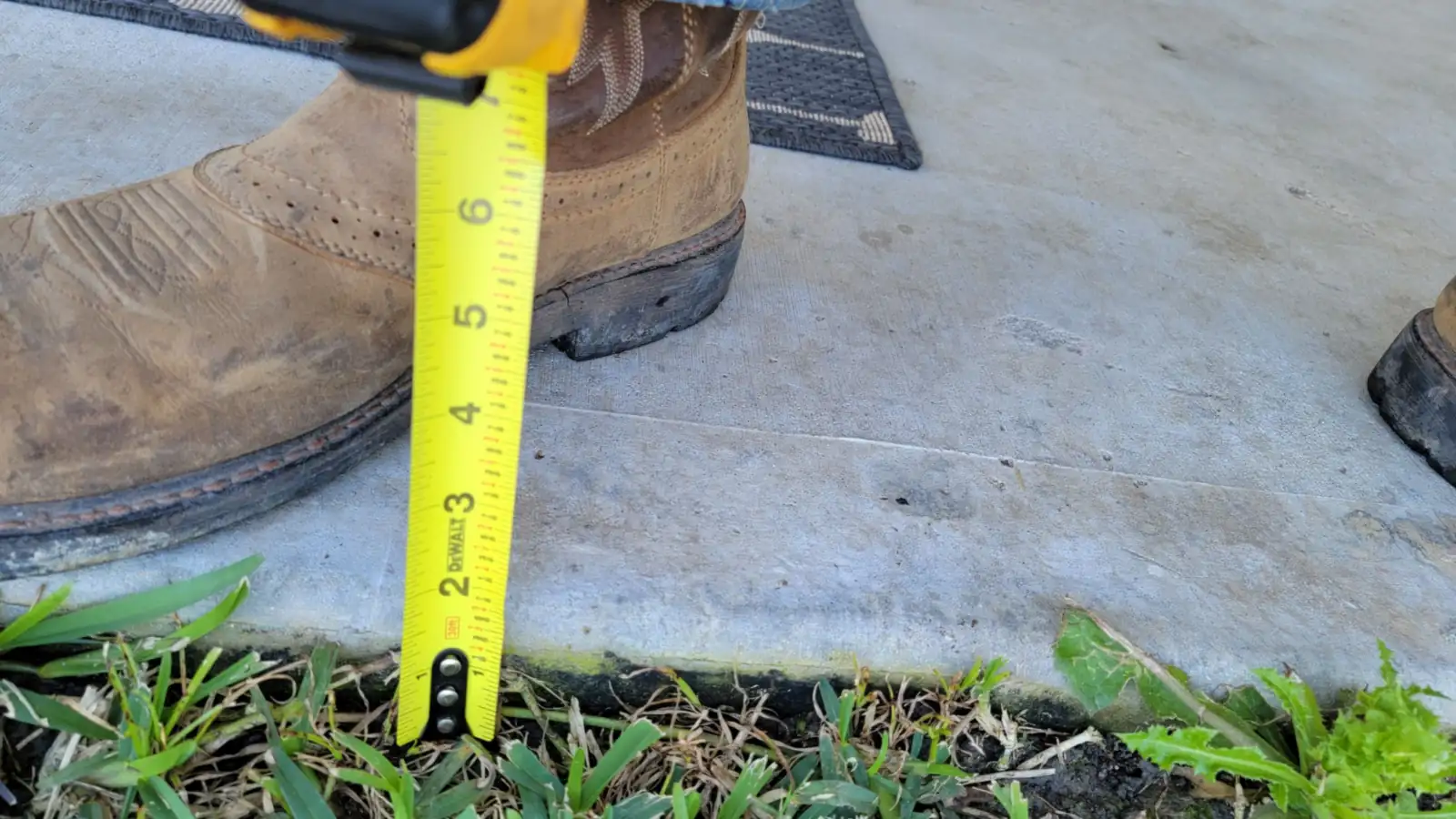
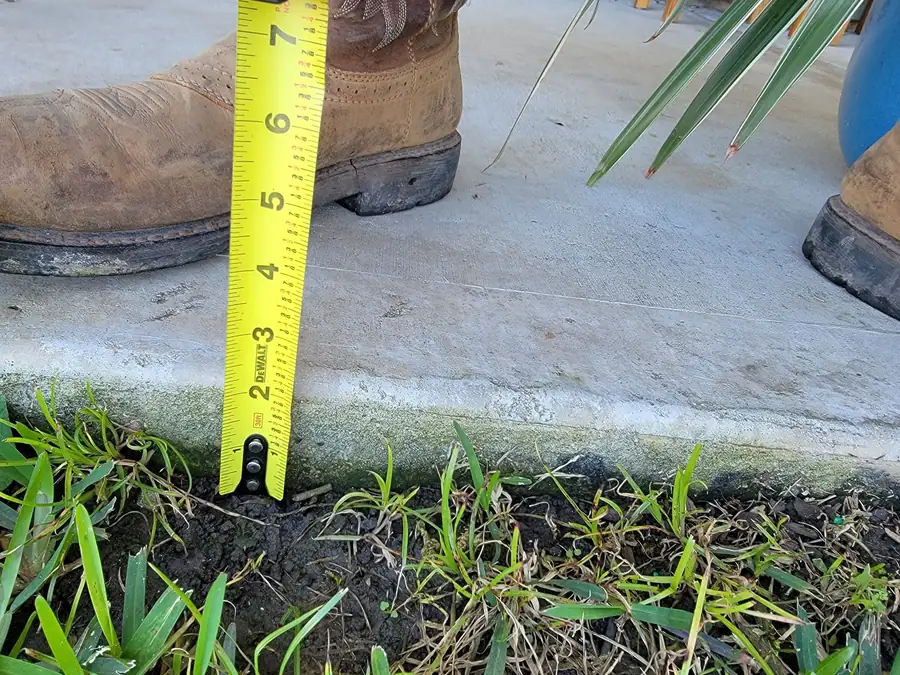
You can measure grade with a string, a line level, two stakes and a tape measure. Run a level string out 10 feet from the foundation and measure down from the string to the ground at the wall and at the far stake. The far measurement should be at least 6 inches greater than the near one.
- Drive a stake against the foundation and a second stake 10 feet straight out into the yard.
- Tie a string to both stakes and hang a line level at its center. Move the string up or down on the outer stake until the bubble is centered.
- Measure from the string down to the soil at the wall, then at the outer stake.
- Subtract the first number from the second. Six inches or more meets the code target. Zero or a negative number means the ground slopes toward the house.
- Repeat every 10 to 15 feet around the house, and at every downspout and inside corner.
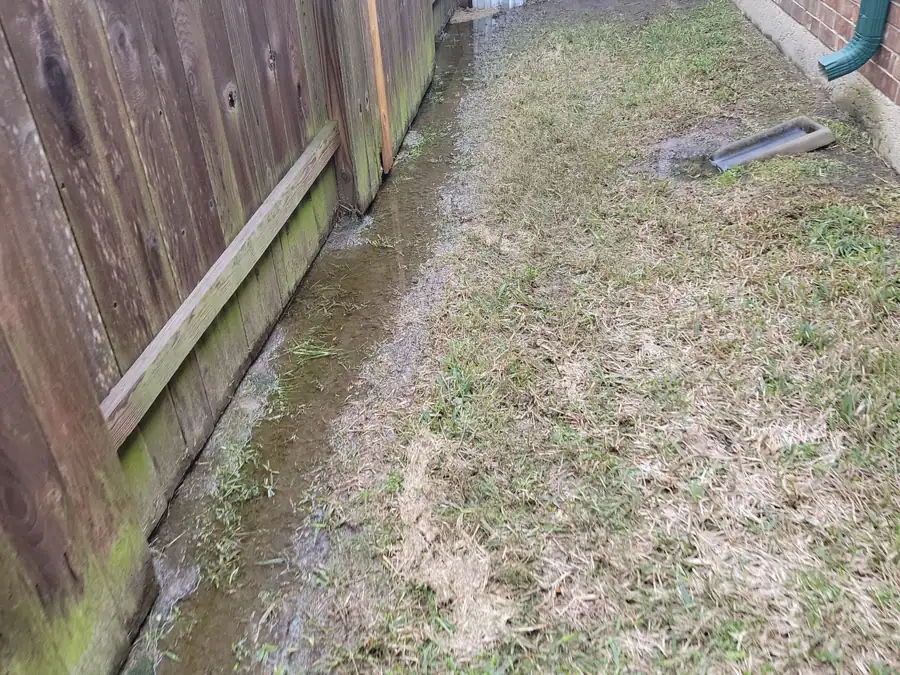
Professionals use a laser level or a builder's level and take readings across the whole lot, not just near the house, because the question is not only whether water leaves the wall but where it goes next. A yard can slope correctly away from the slab and still trap water at the fence.
Why does good grading go bad over time?
Grade goes bad slowly, through settlement and additions. Backfill beside a new slab settles over the first few years. Flower beds gain inches of mulch and soil every season. Sod laid on top of old sod raises the lawn. Each change is small, but together they can flatten or reverse the slope a builder left.
Bed borders are a common culprit. A row of edging stones or a brick border along the front of the house holds water in the bed like a tray, right against the slab. Raised beds that touch the wall do the same. Pulling the bed back, lowering the border or leaving gaps for water to escape can fix the problem without moving much soil at all.
Trees play a part too. Roots lift soil in some places, and stumps rot and leave hollows in others. Utility trenches for cable, gas or irrigation often settle into narrow dips that run straight toward the house.
How is a drainage swale between two houses built?
A swale between two houses is a shallow, rounded channel shaped down the middle or along the fence line of the side yard, falling steadily from back to front or front to back toward the street. Both yards slope gently into it, it is compacted and sodded, and its low line must fall the whole way with no flat spots.
The steps are simple to describe and fussy to get right. First, set the outlet elevation, usually at the street or a rear easement. Next, take readings along the side yard to confirm there is enough fall from the high end to the outlet. Then cut the channel, shape the side slopes, compact the soil and lay sod so the swale does not erode in its first storms.
Side yards bring their own limits. AC units, fence posts, gas meters and gates sit in the path. When a swale cannot pass an obstacle, a short length of solid pipe or a grated inlet carries the water past it. When the side yard is too flat to give the swale enough fall, it pairs with a buried drain line, which our French drain vs. swale guide compares in detail.
Because a swale between houses usually sits on or near the property line, it affects both lots. We recommend talking with the neighbor before the work, and it helps to know where the line actually runs.
Does a yard need regrading after an addition, patio or pool?
Usually, yes. Any project that adds a slab or moves soil changes how water crosses the lot. A new patio or room addition raises hard surface next to the house, pool digs leave spoil spread across the yard, and builders backfill quickly. Checking and restoring grade at the end of the project prevents a new wet spot.
Patios are the most common trigger. A slab poured flush with the back door often leaves the soil beyond it higher than the concrete, so runoff collects at the patio edge and runs toward the house. The code target for hard surfaces near the house is a 2 percent fall away from the building, and the soil past the edge needs to continue that fall rather than block it.
Room additions shift water too. The new roof adds downspouts in new places, and the new footprint can cut across a path water used to take around the house. Pool projects often end with surplus soil spread across the yard, which can bury old outlets and fill existing swales. After any of these, it is worth repeating the string-and-level check before the new lawn goes in.
When is grading not enough?
Grading is not enough when there is nowhere lower for the water to go, when a fence, slab or neighbor's yard blocks the needed fall, or when the soil stays saturated after the surface has drained. In those cases the grade still helps, but a buried drain, inlets or a pump has to finish the job.
The yard is lower than the street. If the curb sits higher than the back of the lot, no amount of shaping makes water flow there. Water has to be collected and lifted with an outdoor sump pump, covered on our sump pumps page.
There is not enough room. On zero-lot-line side yards, getting a 5 percent slope away from the wall can leave the soil far below the fence or steep enough to wash out. The code anticipates this with its drains-or-swales exception, and in practice the answer is often an inlet line along the wall. See our catch basins page.
The ground stays wet underneath. Grading moves water on the surface. If the soil stays soggy for days after the surface is dry, the water is below ground, and a French drain is the tool for that, described on our French drain installation page.
Most wet lots end up with some mix of these. Our yard drainage page lays out how grading, swales and drains are combined on one plan.
How is grading and swale work priced?
Grading is priced by how much soil has to be moved or brought in, how far it travels, how much sod has to be replaced, and how easy the yard is to reach. A swale adds the length of channel and any pipe or inlets needed to get past obstacles. Hand work in tight side yards takes longer than machine work in an open lawn.
We take elevation readings during the free on-site assessment and give you a written number for the specific grading and swale work your lot needs. Use the form on this page or request a quote to set up the visit.
Other drainage services
French Drain Installation
A perforated pipe in a gravel trench that collects water below the surface and carries it to a safe outlet.
Learn more →French Drain Repair
Clogged, crushed or silted-up drains diagnosed and repaired, or rebuilt when the old one cannot be saved.
Learn more →Yard Drainage
Standing water, soggy low spots and runoff toward the house, solved with the right mix of drains and grading.
Learn more →Catch Basins
A grated box set at the low spot that catches surface water and sends it into an underground pipe to the outlet.
Learn more →Channel and Trench Drains
A long grated channel across a driveway, patio or garage entry that stops sheet runoff before it reaches the house.
Learn more →Downspout Drain Lines
Solid underground pipe that carries roof water from each downspout to the street or an outlet instead of the foundation.
Learn more →Sump Pumps
For lots with no downhill exit: a basin and pump that lift collected water up and out to where it can drain.
Learn more →
Grading and swale questions
How much should the ground slope away from my house?
The International Residential Code asks for the grade to fall at least 6 inches within the first 10 feet from the foundation, which is a 5 percent slope. Where a lot line or wall makes that impossible, the current code text allows a 5 percent slope to drains or swales instead. Your city may enforce a different edition, so we check.
What is the difference between grading and a swale?
Grading sets the overall tilt of the yard so water leaves the house. A swale is one shaped channel within that grade, a broad, shallow, grassed dip that collects the water moving off the slopes and carries it along a single path, such as down a side yard to the street or along a back fence.
Can I regrade my yard myself?
Small fixes, such as pulling mulch back from the slab or adding a few inches of soil against a settled foundation, are reasonable weekend work. Moving larger amounts of soil, cutting a swale with real fall over a long distance, or working near utility lines calls for elevation readings, compaction and a utility locate first.
What kind of soil is used to regrade around a foundation?
Fill placed next to a slab should be a compactable soil that sheds water, laid in thin layers and tamped, then topped with enough topsoil to grow grass. Loose sandy fill or bagged mulch piled against the house soaks up water and holds it right where you want the ground to stay driest.
How wide does a drainage swale need to be?
Wide enough to carry the water without washing out and gentle enough to mow, which usually means a dip a few feet across and only a few inches deep. On narrow side yards the swale may take nearly the full width between the house and the fence, so the shape is set by the space you have.
Will regrading change my sprinkler system or beds?
Often, yes. Sprinkler heads may need raising or lowering to the new grade, and bed borders that trap water against the house may need to be cut back, lowered or given a gap. We point these out during the assessment so the quote includes them.
Stop the standing water before the next storm
Tell us where the water collects. We will come out, find where it should go, and give you a price.