
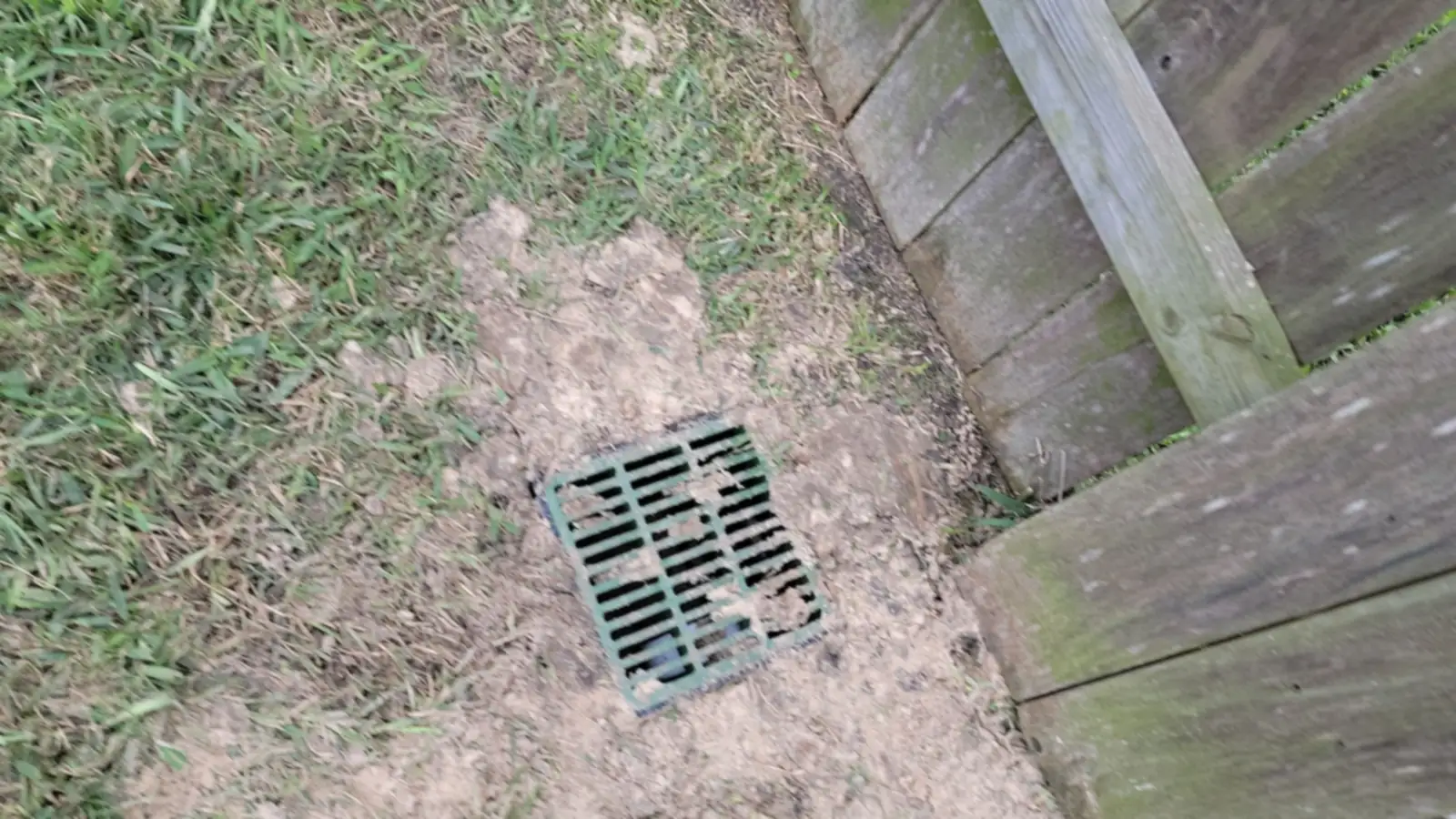
Catch Basin Installation in League City and Galveston County
If rain pools in the same corner of the yard every storm, a catch basin gives that water a way out. A grated box set at the true low point collects the runoff, traps the grit, and sends the water through buried pipe to the curb or another outlet. Here is how we decide where one goes, what size it should be, and what it takes to keep it working on flat Gulf Coast lots.
- Free on-site assessment
- French drains and yard drainage
- Repairs to existing drains
- Office in League City
What does a catch basin installation include?
A catch basin installation is three parts working as one: a grated box at the low spot, a sealed pipe laid with steady fall, and an outlet that can legally take the water. Leave out any one of them and the system stalls. A good box with a bad outlet is still a puddle.
The box is the part you see. Under the grate is an open chamber with knockouts on its sides, where the outlet pipe connects. Below those knockouts sits a short sump. Grit, mulch and grass clippings drop into that sump instead of riding into the pipe.
The pipe is the part that does the work. It runs from the basin to the discharge point, and every foot of it has to fall toward that point. A belly in the line holds water and silt, and in time that sag becomes a clog.
The outlet is where the job is won or lost. On most lots in our area it is the street curb, a roadside ditch, or a drainage easement behind the house. Where none of those is downhill, the water goes to a pump basin instead. Our yard sump pump page covers that case.
Catch basin or French drain: which one does your yard need?
Pick a catch basin when water collects on the surface at one spot and you can watch it sit there. Pick a French drain when the ground stays soggy along a strip long after the rain stops. A basin gathers water that is above the soil. A French drain gathers water that is already in it.
The difference matters because the two are built differently. A basin is fed by gravity through an open grate, so it reacts in seconds. A French drain is a perforated pipe in a gravel trench wrapped in fabric, and it collects water slowly as the soil gives it up.
| What you see | Likely fix | Why |
|---|---|---|
| A puddle in one corner that lasts a day or two | Catch basin | Surface water with one clear low point |
| A muddy strip along a fence or the slab | French drain | Water moving through the soil along a line |
| A puddle at the bottom of a soggy slope | Both, on one pipe | The basin takes the surface flow; the trench takes the seepage |
| Water sheeting across a patio or driveway | Channel drain | The flow is spread along an edge, not focused at a point |
Plenty of yards need both. A common layout puts a basin at each low spot and runs the French drain trench between them. Both feed one solid main. The basins handle the burst of a storm, and the trench dries the soil over the next few days. When the problem is a long hard edge instead of a point, a channel drain is usually the better collector.
Where should a catch basin go on a flat Galveston County lot?
A catch basin goes at the true low point of the area that drains to it, and on flat coastal lots that point is often a few feet from where the puddle looks deepest. We find it with a laser level, not by eye. A basin set even an inch above the low spot leaves a ring of standing water around the grate.
Our ground makes this harder than it sounds. Much of Southeast Texas between the Colorado and Trinity rivers sits on clayey coastal-plain soils such as the Lake Charles series, which the USDA describes as very slowly permeable, mostly on slopes under 1 percent, with high runoff. Water does not soak in fast, and it does not run off fast either.
The usual places a basin earns its keep:
- The back corner where two neighbors' yards and yours all meet.
- The side yard between two houses, where both roofs and both slopes dump into a narrow strip.
- The edge of a patio poured level with the lawn, where water stalls against the concrete.
- Beside a downspout outlet that has nowhere else to go.
- The low pocket at the bottom of a planting bed that holds water against the slab.
Sometimes the low point is in a bad place, right against the foundation, say. Then we either set the basin a short distance out and reshape the ground toward it, or pair it with grading or a shallow swale that moves the water before it collects.
What size catch basin and pipe does a yard need?
Size follows the area draining to the basin and how much debris will reach it. Residential basins come in square sizes of 9, 12, 18 and 24 inches. NDS, one of the common makers, sells adapters that connect them to drain pipe from 3 to 12 inches. A typical yard low spot gets a 12-inch basin on 4-inch pipe.
| Basin size | Typical use | Usual outlet pipe |
|---|---|---|
| 9-inch | A single downspout, a small bed, a narrow walkway | 3 or 4 inch |
| 12-inch | A lawn low spot, a side yard, a patio corner | 4 inch |
| 18-inch | Several downspouts or a large backyard draining to one point | 4 or 6 inch |
| 24-inch | The collection point for a whole lot, or heavy leaf loads | 6 inch |
The table is a starting point, not a rule. A bigger box mainly buys more sump space and more grate area for leaves to collect on before the opening blinds over. The pipe sets the real capacity. If three basins share one line, that line has to carry all three at once, which is why bigger systems step up to 6-inch pipe on the main.
We favor smooth-wall pipe for basin lines. Its slick interior carries silt through instead of trapping it in ribs, and it holds its grade in clay better than thin corrugated tubing.
Which grate fits a lawn, a bed, a patio or a driveway?
Match the grate to what sits around it and what rolls over it. A flat green grate disappears in turf. A domed or atrium grate sits above mulch so the slots stay open. A low-profile grate set flush with pavers suits a patio, and a heavier-rated grate in a concrete collar is needed anywhere a car tire lands.
- Flat grate. Sits level with the soil in a lawn. Mowers pass over it. Green or black blends in.
- Domed (atrium) grate. Rises a few inches so leaves and mulch slide off and water still gets in from the sides. Good in planting beds and under trees.
- Decorative or flush grate. Sits in pavers or a patio border so nobody catches a heel.
- Vehicle-rated grate. Cast iron or a heavy-duty composite rated for the load, set in a poured collar. Standard lawn grates crack under tires.
The grate has to sit a touch below the finished surface, never above it. Water will not climb a lip.
How is a yard catch basin installed, step by step?
The install runs in a fixed order: locate utilities, set the grade, dig, bed and set the box, lay the pipe to the outlet, test with water, then backfill and restore. Skipping the water test is the most common shortcut, and it hides the one mistake that matters, which is a pipe that does not fall all the way.
- Call in the utilities. Texas811 asks homeowners and contractors to make the locate request at least two business days before digging, weekends and holidays not counted. Gas and electric lines often cross the same front yard a curb line does.
- Shoot the grades. We measure from the low point to the outlet and confirm there is enough fall for the pipe. If there is not, the plan changes now, not after the trench is open.
- Dig and bed. The hole goes a few inches below the box so it can sit on compacted base, which keeps it from settling and tilting.
- Set the box. Level, at the right height, with the outlet knockout facing the pipe run.
- Lay the pipe. Glued or gasketed joints, fall checked as each length goes down.
- Test. A hose or bucket in the grate, and someone watching the outlet.
- Backfill and restore. Soil compacted in lifts around the box, then sod or mulch put back.
Where can the water go once it is in the pipe?
It has to end somewhere lower than the basin that can accept it: the curb, a roadside ditch, a drainage easement, or a pump basin. It cannot be aimed onto a neighbor's lot. On flat lots the outlet is the hardest part of the design, and it sets how deep the basin can be.
Curb outlets sit in the public right-of-way, so the rules belong to the city or county that owns the street, and they differ from place to place. We check the requirement for that address before coring a curb. HOAs may also have a say on visible grates in front yards.
How do you keep a catch basin from clogging, smelling or breeding mosquitoes?
Clear the grate when leaves build up, scoop the sump a couple of times a year and after big storms, and make sure the outlet is open. A basin that empties completely between rains stays clean. One that holds water for days will smell and can hold mosquito larvae.
- Grate: brush it off after mowing and after storms; clippings mat over the slots fast.
- Sump: lift the grate and pull out the silt and leaves by hand or with a shop vac.
- Outlet: look at the curb or emitter end during a rain. No flow there with water in the basin means a blockage in between.
- Filter inserts: some basins take a fabric or plastic insert that catches fine debris. It helps under trees, but it must be emptied or it becomes the clog.
If a basin that used to work has started backing up, the line may need cleaning or a fix; our drain repair page covers how we trace it.
What drives the price of a catch basin job?
We do not post a flat price, because the box is the cheap part. Cost is driven by how many basins, how far the pipe runs, how deep it has to go to keep its fall, what it crosses on the way (sidewalks, beds, roots, other lines), and what the outlet needs. You get a written number after the free on-site assessment.
The things that move a quote most:
- Pipe length from the farthest basin to the outlet.
- Boring or cutting under a sidewalk or driveway on the way to the street.
- Vehicle-rated grates and concrete collars.
- A pump basin where gravity cannot reach the outlet.
- Sod and bed restoration once the trench is closed.
To have us walk the yard and mark the low points, request a quote or call our League City office at 409-572-6657.
Other drainage services
French Drain Installation
A perforated pipe in a gravel trench that collects water below the surface and carries it to a safe outlet.
Learn more →French Drain Repair
Clogged, crushed or silted-up drains diagnosed and repaired, or rebuilt when the old one cannot be saved.
Learn more →Yard Drainage
Standing water, soggy low spots and runoff toward the house, solved with the right mix of drains and grading.
Learn more →Channel and Trench Drains
A long grated channel across a driveway, patio or garage entry that stops sheet runoff before it reaches the house.
Learn more →Downspout Drain Lines
Solid underground pipe that carries roof water from each downspout to the street or an outlet instead of the foundation.
Learn more →Sump Pumps
For lots with no downhill exit: a basin and pump that lift collected water up and out to where it can drain.
Learn more →Grading and Swales
Reshaping the ground, or cutting a shallow channel, so surface water flows away from the house on its own.
Learn more →
Catch basin questions
How long does a yard catch basin installation take?
A single basin with a short run of pipe to the curb is usually a one-day job. Each extra basin, a long run across the lot, or a pipe that has to pass under a sidewalk or flatwork adds time, and we lay that out in the written quote after the site visit.
Can a catch basin go in the middle of my lawn?
Yes. A square grate in turf sits at soil level so the mower rolls over it, and the sod is cut and relaid around it. The basin only works if that spot is the true low point, so we shoot grades first; sometimes the lawn needs a little reshaping to steer water to the grate.
Why does water still stand next to my catch basin?
Usually the grate was set too high, so water has to climb a lip to get in, or the box is half full of silt. Less often the outlet pipe is flat, crushed or buried at its end. Lowering the grate and clearing the box fixes the first two; a blocked outlet needs the line traced.
Will a catch basin smell or draw mosquitoes?
A basin that drains fully between storms does not. The trouble comes from a sump left holding water and rotting leaves for days. Keeping the outlet clear, choosing a basin depth that empties, and pulling debris after storms keeps the box dry enough that it does not become a breeding pool.
Is a plastic catch basin strong enough?
In lawns, beds and walkways, yes: residential basins are molded polyethylene or polypropylene and the soil around them carries the load. Where tires will cross the grate, such as a driveway edge, we set the box in a concrete collar and use a grate rated for vehicles instead of a standard lawn grate.
Do I need a catch basin if I already have gutters?
Gutters handle the roof; a catch basin handles the ground. If water still pools in the yard after the downspouts are piped away, that water is coming off the lawn, the patio or a neighbor's lot, and a basin at the low point is what collects it.
Can one pipe serve several catch basins?
Yes. Basins can be set in a row along a side yard or across a backyard and joined by one main line, as long as that pipe is sized for the combined flow and keeps its fall all the way to the outlet. Larger systems often step up from 4-inch to 6-inch pipe.
Stop the standing water before the next storm
Tell us where the water collects. We will come out, find where it should go, and give you a price.