
French Drain Repair: Why It Stopped Draining and How to Fix It
A French drain that used to keep the yard dry and now leaves a soggy strip is not worn out by age alone. Something specific stopped it: a buried outlet, silt in the stone, roots in the pipe, a crushed section, or roof grit from a tied-in downspout. Repair starts by finding which one, and where.
- Free on-site assessment
- French drains and yard drainage
- Repairs to existing drains
- Office in League City
What are the signs a French drain is failing?
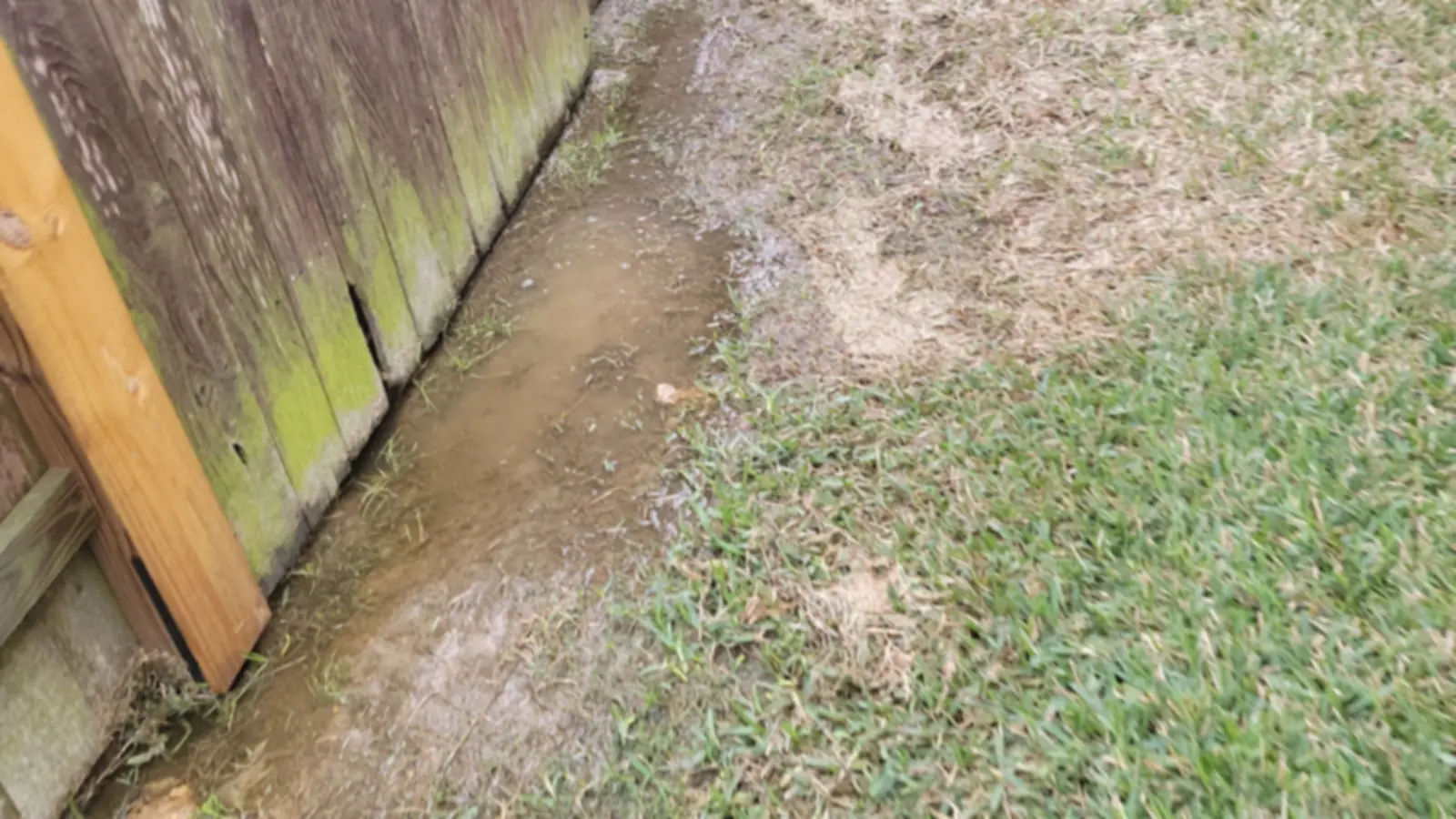
A failing French drain shows itself in the places it was built to keep dry. Water stands over the drain route after rain. A strip of lawn along the line stays soft for days. The downspout connection bubbles or overflows in a storm. Or the outlet stays dry while the yard floods, which means water goes in and never comes out.
Other signs are slower. Grass over the trench turns greener than the rest of the yard because it sits on wet soil. A sinkhole or a narrow depression opens along the route, which usually means soil is washing into a broken pipe. Mosquitoes hang around a pop-up emitter that never fully drains.
None of these tells you the cause by itself. A drain that is completely blocked and a drain with a buried outlet look the same from the patio. That is why repair begins with a diagnosis, not a shovel.
| What you see | Most likely cause | First thing we check |
|---|---|---|
| Outlet dry during heavy rain | Blockage, break, or buried outlet | Whether the outlet is open and flowing |
| Water bubbling up at a downspout | Line undersized for roof water, or partly blocked | Camera from the downspout connection |
| Wet strip along the whole route | Gravel packed with silt, or pipe laid flat | Test hole into the stone; slope readings |
| Sinkhole over one spot | Crushed or separated pipe | Camera to that spot, then open it |
| Water stands in one low section only | A sag holding water in the pipe | Camera footage and elevation shots |
Why start at the outlet?
Start at the outlet because a French drain can only empty as fast as its exit allows. If the outlet is buried, crushed or capped, every foot of pipe upstream fills and stops working, even when the pipe itself is perfect. Checking the outlet first can turn a suspected rebuild into an afternoon of digging out one fitting.
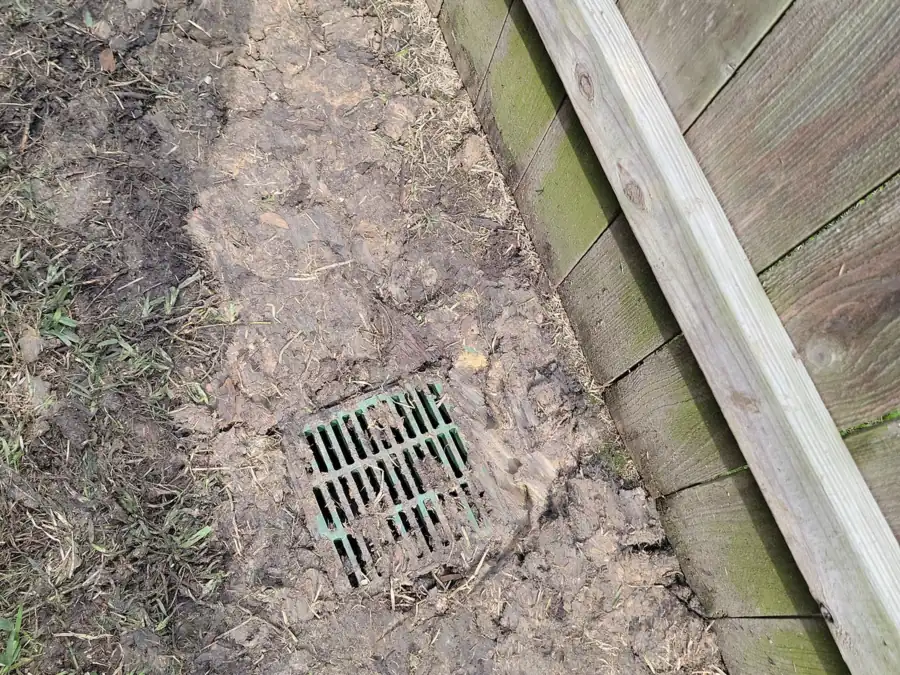
Outlets get lost more often than people expect. A pop-up emitter in the lawn gets covered by sod or topdressing and stays shut. A pipe end at the curb gets packed with street sand or crushed when a driveway apron is poured. A discharge into a ditch gets buried when the ditch is cleaned or regraded. A previous owner landscapes over the outlet without knowing what it was.
Finding it is the first job. We walk the likely path downhill from the drain, probe for the pipe, and, if needed, push a camera or a locating sonde in from an upstream cleanout to trace the line to where it ends. Once the outlet is found, we run water into the top of the system and watch whether it arrives, how fast, and how clean.
If water reaches the outlet freely, the problem is not a blockage. If it never arrives, the problem is somewhere in between, and the search narrows from there.
How do silt, fabric and roots stop a French drain?
Silt, missing fabric and roots all do the same thing: they close the spaces water has to move through. A French drain works because water flows easily through clean stone and into the pipe's holes. When fine soil fills those gaps or roots fill the pipe, water moves slower than it arrives, and the trench becomes a buried, soggy line.
Silt. Clay soil is made of very fine particles. Each time water seeps into a drain, it carries a little of that fine material with it. Over time it settles in the bottom of the pipe and coats the stone. In a drain with a cleanout and a free outlet, much of this washes through. In a flat or poorly vented line, it builds up.
Fabric. Filter fabric is the cloth that lines the trench and wraps the stone so soil stays outside and water passes in. Drains built without it, or with the wrong kind, let clay migrate straight into the gravel. That failure cannot be flushed away, because the clog is in the stone, not just the pipe. Fabric can also clog itself when the wrong weave is used against fine clay, which looks like a clean pipe inside a trench that will not take water.
Roots. Tree and shrub roots grow toward steady moisture, and a drain line is exactly that. Fine roots enter through the perforations, then thicken into a mat that catches silt and leaves. A line run close to a tree, a hedge or a bed of thirsty shrubs is the usual suspect.
What do sags and crushed pipe do to a drain?
A sag is a low spot in the pipe where water sits instead of flowing on, and a crushed section is a place where the pipe has collapsed. Both cut the drain's capacity at one point, and everything upstream backs up behind it. Both also trap silt, so a small sag slowly becomes a full blockage.
Sags come from the way the pipe was laid. If the trench bottom was not shaped to a steady fall, or the pipe was set on loose soil that later settled, the line can dip and rise along its length. Thin corrugated pipe is more prone to this than rigid pipe because it follows whatever the trench bottom does.
Crushing usually comes from weight. A vehicle parked over a shallow line, a trailer backed across the yard, a skid steer working on a pool or fence job, or a new driveway poured over the route can all flatten pipe. Clay soil that swells when wet and shrinks when dry also pushes on a buried line, season after season.
Joints are the third weak point. Couplings that were never glued or taped pull apart as soil moves, and the gap lets soil pour in. That is often the cause behind a sinkhole that keeps coming back in the same spot.
Should downspouts be tied into a French drain?
Usually they should not share the same perforated pipe. A French drain is built to collect groundwater slowly along its length; a downspout delivers a burst of roof water, grit and leaf debris all at once. Tying the two together overloads the drain in storms and fills it with roof debris between them.
The volume is larger than it looks. Texas A&M AgriLife notes that one inch of rain on 1,000 square feet of roof can produce about 620 gallons of water. Several downspouts feeding one perforated line during a Gulf storm can push water back out of the holes into the very soil the drain is supposed to dry.
Roof grit is the other problem. Shingles shed granules, and gutters collect leaves, seeds and pollen. All of it washes into the drain, settles in the low spots, and feeds root growth. A failed drain with downspouts tied in is often full of black sludge and shingle sand when it is opened.
The repair is usually to separate them: give the roof water its own solid pipe to the outlet, and let the French drain go back to collecting groundwater. We cover that work on our underground downspout drain lines page.
How do camera inspection and jetting work on a French drain?
A camera inspection pushes a small waterproof camera on a flexible cable through the drain pipe from a cleanout, a downspout connection or the outlet. It shows roots, silt, crushed sections, separated joints and standing water in sags, and it records how far in each problem sits so the right spot can be opened.
Many locating cameras carry a transmitter in the head. From the surface, a receiver picks up that signal, so we can mark the exact spot and depth of a problem on the lawn. That is what lets a repair open three feet of yard instead of thirty.
Jetting is the cleaning step. A hose with a nozzle that sprays water backward pulls itself up the pipe and scours silt, sand and fine roots loose, flushing them toward the outlet. It works well on a sound pipe with debris inside. It does not repair a crushed pipe or fix gravel that is clogged with clay, and it cannot help if the outlet is blocked, because the loosened silt has nowhere to go.
A sound sequence is outlet first, then camera, then jetting if the camera shows a cleanable line, then a second camera run to confirm the result. If a drain has no cleanout, we often add one during the visit so the next cleaning does not need any digging.
Clean, repair or rebuild: how is the decision made?
The decision depends on where the failure is. If the clog is inside a sound pipe, the drain is cleaned. If one stretch is crushed, separated or sagging, that stretch is repaired. If the stone along most of the route is packed with clay, or the line was laid with no real fall, the drain is rebuilt, because neither cleaning nor patching will last.
| What the inspection finds | Fix | What it involves |
|---|---|---|
| Outlet buried or blocked, line otherwise clear | Outlet repair | Dig out, replace or raise the outlet fitting; add a grate or emitter that can be found again |
| Silt, sand or fine roots inside an intact pipe | Clean | Jet the line from a cleanout; add a cleanout if missing |
| One crushed, sagging or separated section | Spot repair | Open that stretch, reset the pipe at a steady fall, rewrap and backfill |
| Downspouts tied into the perforated pipe | Separate | Run roof water in its own solid line to the outlet |
| Stone clogged with clay along most of the run | Rebuild | New fabric-lined trench, clean stone, new perforated pipe, working outlet |
| Line laid flat or with no outlet at all | Rebuild or redesign | New route with real fall to a real discharge point |
A rebuild is not the same as a new install in a new place. Often the old route was right and only the build was wrong, so the new drain follows the same line with correct materials. Our French drain installation page explains how a new run is built from the outlet up.
Before any trench is opened, the dig site has to be cleared for buried utilities. Texas law requires an excavator to notify a one-call notification center such as Texas 811 at least 48 hours before digging, not counting Saturdays, Sundays or legal holidays, so a spot repair or rebuild is scheduled with that window in mind.
Was a French drain even the right fix?
Sometimes the honest answer is no. A French drain collects water that is soaking into the ground. If the real problem is water running across the surface in a sheet, or a yard that slopes toward the house, a French drain will keep failing however well it is repaired, because it was never the right tool.
Signs the original design was the problem: the drain runs along the top of a slope instead of across the path of the water, the yard has no low point the line can drain to, or the water arrives faster than any buried pipe can take it in, such as runoff from a neighbor's lot or a long driveway. In those yards, a surface inlet, a swale or regrading does the work a French drain cannot.
That is part of every repair visit. If rebuilding the drain would only repeat the original mistake, we say so and lay out what would actually work, whether that is reshaping the ground covered on our grading and swales page, adding inlets from our catch basins page, or a combined plan for the whole lot on our yard drainage page.
Repair pricing depends on what the inspection finds, how much of the line has to be opened, access along fences and beds, and where the outlet is. After the free on-site visit you get a written number for the specific repair, not a range. To set up the visit, use the form on this page or request a quote.
Other drainage services
French Drain Installation
A perforated pipe in a gravel trench that collects water below the surface and carries it to a safe outlet.
Learn more →Yard Drainage
Standing water, soggy low spots and runoff toward the house, solved with the right mix of drains and grading.
Learn more →Catch Basins
A grated box set at the low spot that catches surface water and sends it into an underground pipe to the outlet.
Learn more →Channel and Trench Drains
A long grated channel across a driveway, patio or garage entry that stops sheet runoff before it reaches the house.
Learn more →Downspout Drain Lines
Solid underground pipe that carries roof water from each downspout to the street or an outlet instead of the foundation.
Learn more →Sump Pumps
For lots with no downhill exit: a basin and pump that lift collected water up and out to where it can drain.
Learn more →Grading and Swales
Reshaping the ground, or cutting a shallow channel, so surface water flows away from the house on its own.
Learn more →
French drain repair questions
How can I find where my French drain comes out?
Walk downhill from the drain line toward the street, a ditch or a back easement and look for a round grate, a pop-up emitter cap, or a pipe end at the curb. If nothing shows, the outlet is probably buried under sod or mulch, and a probe, a locating wire or a camera run from an upstream cleanout will find it.
Is it cheaper to clean a French drain or replace it?
Cleaning costs less whenever it actually works, which is when the pipe is intact and the stone around it still lets water through. Once the gravel is packed with fine clay, flushing the pipe buys a few weeks at most, and rebuilding that run is the cheaper choice over the life of the drain.
How do I tell if my French drain was built without filter fabric?
Dig a small hole at one spot along the line and look at the stone. Gravel with no fabric lining the trench shows soil mixed into it, often gray clay coating the rock and filling the spaces between stones. A drain built with fabric shows clean stone inside a cloth wrap, with the soil kept on the outside.
Will repairing my French drain tear up the whole yard?
Usually not. When a camera or a water test pins the failure to one stretch, only that stretch is opened, sod is cut and set aside, and the trench is backfilled and restored. A full rebuild disturbs the whole route, but the trench is narrow and the lawn on either side stays in place.
Can a French drain be cleaned with a pressure washer?
A household pressure washer with a sewer-jetter hose attachment can push out loose leaves and sand near a cleanout, but it lacks the flow to clear a long run. It also cannot fix silt in the gravel, roots that have grown through the pipe wall, or a crushed section, which are the usual reasons a drain stops working.
Why does my French drain gurgle or overflow at the downspout?
Water backing up at a downspout connection means the pipe downstream cannot carry what the roof is sending it. Either the line is partly blocked, the outlet is too small or buried, or the roof and the yard are sharing one pipe that was never sized for both. A camera run shows which one it is.
Do you repair French drains another company installed?
Yes. Many failing drains were built years ago by another installer or a previous owner, with no drawing of where they run. We trace the line from the outlet, test it, and repair only the part that failed when that is enough to make it work again.
Stop the standing water before the next storm
Tell us where the water collects. We will come out, find where it should go, and give you a price.